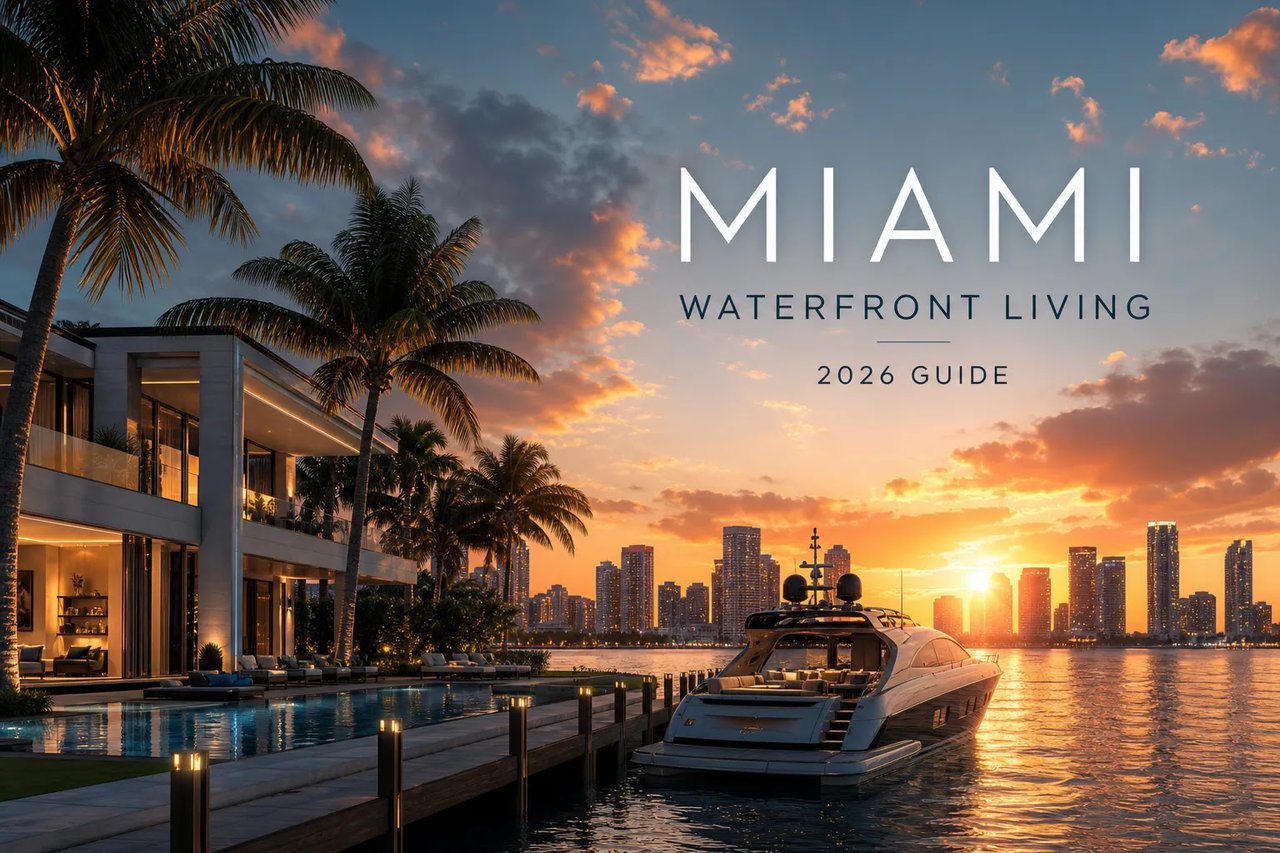
Not every home on the water qualifies as a Miami waterfront estate in the city's luxury market. The threshold for this category is specific: lot size, water frontage footage, private dock capability, and privacy infrastructure. These aren't marketing adjectives applied loosely to move inventory. They're measurable standards that can correspond to differences of an order of magnitude in value, and buyers need to understand that distinction before they start looking.
Think of Miami's waterfront estate market as a collector's market, where the asset either qualifies or it doesn't, and the criteria are unforgiving at the top end. This guide covers how to define the category, where the best inventory lives, what ownership actually costs, and what due diligence looks like at this level. The framework here reflects the kind of expertise a seasoned boutique luxury broker brings to every buyer navigating this highly curated segment, where the right property requires a discerning eye on both sides of the transaction.
Miami Waterfront Estates: What Actually Defines Them
Lot size, frontage, and the deep-water standard
Standard luxury waterfront estates in Miami sit on 0.38 to 0.87 acres with 100 to 400 feet of water frontage. Trophy properties scale well beyond that: Gables Estates sets the benchmark at up to 2.55 acres with 530 feet of frontage. Size matters, but so does what the water can actually accommodate. The deep-water standard means the lot can berth an 80-foot-plus yacht with no fixed bridge restrictions blocking ocean access. That specific combination of depth, clearance, and frontage is one of the primary drivers of the price premium at the top of the market.
Private dock access: what qualifies and what doesn't
There is a meaningful difference between a deeded slip in a community marina, a shared dock, and a private dock with a boat lift on owner-controlled frontage. True waterfront estates have the latter: private, owner-controlled docking infrastructure with direct access to open water. "No fixed bridges" is not a casual selling point. For buyers intending to keep a serious vessel, it means unrestricted passage to the bay and ocean without height limitations dictating what you can own.
Privacy and security features that define the category
At the estate level, privacy is structural, not cosmetic. Properties on Star Island and Palm Island have controlled access at the bridge itself, meaning vehicle entry is screened before anyone reaches the residential streets. Beyond gated entry, true estates feature motor courts, mature landscaping buffers with meaningful setback configurations, and perimeter infrastructure that creates genuine separation from public sight lines. These features don't just add to livability; they preserve value by ensuring that privacy holds as the surrounding area evolves.
Miami Waterfront Estates by Neighborhood: Price Benchmarks for 2026
Ultra-luxury islands: Star Island, Palm Island, and Hibiscus Island
Star Island sits at a 2026 median of $41.45 million for single-family waterfront properties, with a record sale at $120 million setting the ceiling. Palm Island's median is $27.7 million, with an average closer to $35.6 million. Hibiscus Island trades at a median of $18.9 million and approximately $4,454 per square foot. These three barrier islands represent the most controlled, trophy-branded inventory in Miami, with gated bridge access and a finite number of parcels by design.
Inventory across all three is deliberately thin. When the right property is priced correctly, it doesn't linger. Buyers who approach these islands without pre-established broker relationships and clear financial positioning routinely miss opportunities that never reach broad market exposure.
Coconut Grove and Gables Estates: bayfront with more breathing room
Coconut Grove's waterfront median sits above $5 million, with price per square foot ranging from $850 to $1,800 depending on condition and frontage. Gables Estates offers something the barrier islands can't: genuine estate scale combined with deep-water access and architectural diversity, with lots reaching 2.55 acres and 530 feet of frontage. Neither neighborhood carries the island prestige designation of Star Island, but both deliver the lot sizes and private dock infrastructure that serious buyers prioritize.
These are the right submarkets for buyers whose priority is privacy, acreage, and water access rather than a specific island address. At Gables Estates in particular, the lot dimensions, frontage, and deep-water capability can rival what's available on the barrier islands, making it a compelling option for buyers focused on physical attributes over address prestige.
Key Biscayne and North Bay Road: island lifestyle and city adjacency
Key Biscayne's full waterfront single-family estates closed at a 2026 median of approximately $15.65 million, with waterfront properties averaging around 101 days to pending. The island draws buyers who want a genuinely residential, community-oriented character with limited inventory and real separation from the city.
North Bay Road on Miami Beach offers a historically prestigious bayside address without island overhead, consistently drawing high-net-worth buyers who want proximity to Miami Beach's energy alongside a quieter, more private street presence. Accurate pricing in both areas moves quickly; accessing current data requires direct broker-level contact rather than relying on public listing aggregators.
Miami Waterfront Estates: Ownership Costs Beyond the Purchase Price
Property taxes, carrying costs, and the 2% to 4% rule
Annual property taxes in Miami-Dade run approximately 1.75% of the purchase price for newly acquired properties, where assessed value typically tracks close to the sale price. Total annual carrying costs, combining property taxes, homeowner's insurance, flood and wind coverage, and applicable HOA or maintenance fees, typically land between 2% and 4% of property value. On a $7 million estate, that's $140,000 to $280,000 per year before any capital improvements. That number belongs in every buyer's financial model before an offer is written.
Closing costs add another 2% to 5% at purchase. For waterfront buyers specifically, the composition of those costs matters: title insurance in Miami-Dade is customarily paid by the buyer rather than the seller, and waterfront transactions require specialized seawall, dock, and elevation inspections that don't appear in standard closing cost estimates. Budget accordingly.
Flood and wind insurance: the real numbers at this level
Miami waterfront estates sit predominantly in VE and AE flood zones. Under FEMA's Risk Rating 2.0 framework, premiums are calculated on a property-specific basis, not simply by zone designation. The primary variables are the structure's replacement cost value, its distance to water, and its first-floor elevation relative to the Base Flood Elevation. For luxury properties with high replacement values and close water proximity, annual premiums regularly exceed $10,000 when flood and windstorm coverage are combined.
Miami-Dade's High Velocity Hurricane Zone designation also requires impact-rated glazing and stricter wind load standards throughout, which affects both insurance underwriting and renovation decisions. Elevation above the Base Flood Elevation is the single most effective lever for reducing premiums. Elevation certificates remain foundational documentation for local compliance, insurance underwriting, lender requirements, and any future claims, and while FEMA's Risk Rating 2.0 uses system-generated data for initial federal premium calculations, most lenders and carriers will require or strongly recommend a current certificate for a property in this category.
The Due Diligence No Waterfront Buyer Can Skip
Seawall and dock structural assessments
Seawalls are not covered in a standard home inspection, and most general inspectors won't catch deterioration that an experienced marine contractor or structural engineer would flag immediately. Seawall repair in Miami-Dade runs $150 to $300 per linear foot, scaling to $400 to over $800 per linear foot for full replacement, depending on materials and site conditions. A 200-foot frontage in poor seawall condition represents a $30,000 to $60,000 repair at minimum, significantly more where engineering complexity or permitting requirements expand the scope. This is a buyer cost that never appears on the listing sheet. For an industry-standard list of what to check and when, see this annual seawall and dock inspection checklist.
Dock inspections should evaluate pilings, decking, electrical connections, and any boat lift mechanisms as separate line items. Dockage essentials and permitting are a distinct line item for buyers; deep-water docks in Miami-Dade typically require a Class I permit from DERM, and any dock exceeding 1,000 square feet of over-water surface area triggers a full Florida DEP Environmental Resource Permit. Knowing the permitting status and structural condition of the dock before closing is non-negotiable.
Elevation certificates and FEMA flood mapping
Every waterfront buyer needs a current elevation certificate for the specific property. Start with the FEMA Flood Map Service Center to establish flood zone classification and baseline premium tier under Risk Rating 2.0. Also consult Miami‑Dade flood zone maps for local overlays and DERM-specific requirements, which mandate that finished floor elevation exceed the Base Flood Elevation by at least one foot. An elevation certificate also becomes critical documentation for future financing, refinancing, or insurance claims. Properties with first-floor elevations below BFE carry materially higher premiums, a structural disadvantage that doesn't disappear at resale.
How to Find and Secure the Right Estate in 2026
Reading current inventory conditions
Active waterfront listings across Miami currently total approximately 2,000, but estate-grade inventory, the properties that actually meet the lot, dock, and privacy criteria outlined above, represents a fraction of that figure. Luxury single-family waterfront homes are averaging 47 to 52 days on market in established submarkets, with correctly priced trophy properties moving faster. Inventory increased approximately 12% year-over-year through 2025, which gives qualified buyers more negotiating leverage than existed during the compressed post-pandemic window. The strongest properties at the right price still attract competitive interest, but this is a more measured environment than buyers faced two or three years ago.
Why bespoke representation changes the outcome at this level
At $10 million, $25 million, or $40 million, neither the buy side nor the sell side can afford representation that isn't precisely calibrated to this category. Elaine Kauffmann at Luxury Real Estate Miami focuses on a select client roster so that each buyer of Miami waterfront estates receives direct access to off-market conversations, pre-listing intelligence, and the neighborhood-level granularity that only comes from deep, sustained experience in Miami's most selective submarkets.
That access shortens the search materially. For sellers, it means the qualified buyer finds the property through channels a standard MLS strategy never reaches. For buyers, it means the search stays anchored to properties that genuinely qualify for the estate designation, not a broader pool of waterfront-adjacent listings that don't deliver on the category's core criteria.
Your Next Move
Miami waterfront estates are not a monolithic category. The right one depends entirely on what the buyer is optimizing for: island exclusivity on Star Island or Palm Island, estate scale and deep-water acreage at Gables Estates, community island living on Key Biscayne, or city-adjacent prestige on North Bay Road or in Coconut Grove. Once that preference is clear, the price benchmarks and ownership cost structure become the filters, not the reverse.
Two numbers belong in every buyer's planning model before a property tour is scheduled: the carrying cost estimate of 2% to 4% annually beyond the purchase price, and the due diligence scope covering seawall condition, dock permitting status, elevation certificate, and flood zone classification. These are not details to resolve after an offer is accepted. They are the framework within which the right offer is structured.
If you are ready to shortlist seriously and move with precision, reach out to Elaine Kauffmann directly. The conversation begins with your timeline and the specific criteria that define the right estate for you, and from there, the search is focused on properties that actually qualify.