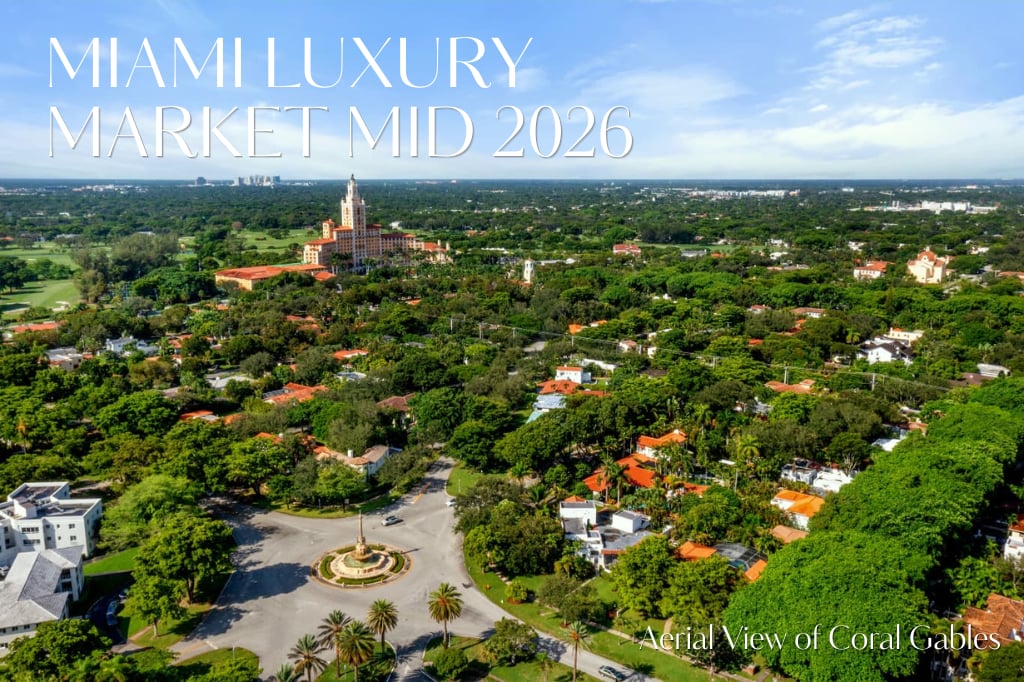
Miami luxury properties in 2026 are not one market. They form a layered collection of micro-markets stacked by price tier, product type, and proximity to water, each operating by slightly different rules. A $3 million budget in Brickell commonly gets you a polished high-rise penthouse with city views. That same budget in Key Biscayne typically buys a standard 2-bedroom older condo in a legacy beachside building. Context is everything.
Elaine Kauffmann has navigated every tier of this market, building a track record across Miami Beach, Coral Gables, Brickell, Key Biscayne, Coconut Grove, and South Miami over more than 15 years on the ground. This guide reflects that perspective: a neighborhood-by-neighborhood, price-by-price breakdown that takes you from understanding what luxury actually costs in 2026, through the product types, to the ownership realities that most buyers discover too late.
What ultra-luxury actually means in the Miami market right now
Nationally, the luxury entry point in 2026 sits around $1.2 million, defined as the top 10% of all listings. Miami operates on a different scale. More than one in five listings in the city exceeds $1 million, and the citywide median closing price of $590,000 tells you exactly how far the luxury tier has diverged from the broader market. These are effectively two different economies sharing the same zip codes.
The three price tiers every Miami buyer needs to know
Think in three working bands: entry luxury runs $1.2 million to $3 million, the luxury tier spans $3 million to $10 million, and ultra-luxury starts at $10 million and extends well beyond. Understanding which tier you're in changes your buying strategy entirely because the competition, the negotiation dynamics, and the inventory sources are different at each level. A $2 million budget buys very different assets in Brickell versus Coral Gables versus Miami Beach, and conflating those markets leads to missed opportunities and misaligned expectations.
Why Star Island and South of Fifth are in a category of their own
At the ultra-prime end of Miami luxury real estate, pricing starts around $15 million and extends well past $100 million. Star Island, South of Fifth, and oceanfront Miami Beach estates are not real estate purchases in the conventional sense. They are collectible assets with global buyer pools, near-zero comparables, and a provenance that functions more like fine art than housing. The $72.25 million sale at 4736 North Bay Road is the clearest reference point for what true trophy pricing looks like in this city. This dynamic ties into the broader international buyer surge that has reshaped demand at the highest price points.
What the $5M to $10M range actually delivers in 2026
This tier is where Miami luxury homes for sale offer the most compelling value-to-lifestyle ratio. Three current listings make the point: the Marea South of Fifth penthouse at $7.95 million delivers floor-to-ceiling ocean views, 2,400 square feet, and boutique concierge service. The St. Regis Bal Harbour at $7.5 million offers oceanfront access with full resort amenities. The 1 Hotel and Homes South Beach at $6.6 million adds short-term rental flexibility and eco-luxury branding. At this price band, buyers can access penthouse finishes, hotel-grade amenities, and direct water access in many cases without stepping into the ultra-prime tier where the buyer pool thins and liquidity slows. For snapshots of notable active listings, see a roundup of top luxury Miami apartments and homes for sale in 2026.
Miami luxury properties: neighborhoods commanding the most attention in 2026
Think of this as a working map for self-selection. Each neighborhood attracts a distinct buyer profile, and matching your lifestyle priorities to the right submarket saves significant time and misdirected offer energy. Geography matters, but buyer intent matters more. The subsections below unpack what each zone actually delivers for the money.
Miami Beach, South of Fifth, and the barrier island tier
Miami Beach spans roughly $2 million to $30 million-plus, with South of Fifth emerging as the most densely priced submarket on the eastern shore. Premium buildings here regularly trade at over $2,000 per square foot, driven by walkability, bay and ocean water views, and consistent international buyer demand that keeps inventory tight. This is the address for buyers who want proximity to world-class dining, art, and culture without sacrificing direct water access.
Key Biscayne and Coconut Grove for privacy-first buyers
These two neighborhoods are the preferred destination for high-net-worth buyers who want estate-scale land, private docks, and residential quiet within 20 minutes of downtown Miami. Key Biscayne homes range from roughly $3 million to $20 million-plus; Coconut Grove single-family estates run $2 million to $15 million-plus. The scarcity of true waterfront lots in both neighborhoods functions as a long-term value driver that no new tower can replicate. The developable inventory has been functionally exhausted, and that constraint only tightens over time.
Coral Gables, Brickell, and Sunny Isles for different buyer profiles
Coral Gables, ranging from $1.5 million to $10 million-plus, attracts families drawn to prestige Mediterranean architecture, mature tree canopies, and top-rated schools. Brickell, priced from $1 million to $5 million-plus, is the city-living option for buyers who want walkable urban luxury anchored in a condo-dominant market. Sunny Isles, spanning $1.5 million to $20 million-plus, is the high-rise oceanfront corridor favored by international buyers, Latin American buyers in particular accounted for 86% of South Florida new-construction global sales in 2025. Each market trades on different fundamentals and rewards different holding strategies.
Miami luxury properties, mansions vs. waterfront condos vs. penthouses
The most common confusion among Miami luxury buyers is the lifestyle and financial tradeoff between owning a waterfront single-family estate and a high-rise luxury condo or penthouse. Both are strong product types in 2026. They are not interchangeable. Knowing which fits your priorities before you start touring saves weeks of misdirected search time.
Price-per-square-foot and what drives the gap
High-rise luxury condo towers in prime Miami submarkets benchmark around $1,445 per square foot, with South Beach and Miami Beach inventory averaging $1,538 per square foot. Waterfront single-family estates are priced primarily by land quality, dockage, and bay or ocean frontage rather than raw square footage, which makes direct per-foot comparisons less uniform. A waterfront estate in Key Biscayne or Coconut Grove can exceed condo pricing per foot because of lot scarcity and the privacy premium, two things no tower can manufacture regardless of the amenity package.
Amenities, privacy, and the lifestyle tradeoff
High-rise condos deliver hotel-grade amenities: staffed lobbies, concierge, managed pools, fitness centers, marina access, and branded experiences in buildings like 1 Hotel and Homes or St. Regis Bal Harbour. Waterfront single-family homes deliver private docks, full outdoor living control, larger lots, and complete ownership of the seawall and pool deck. The right choice is not about which product is objectively superior. It is entirely about how the buyer intends to live in the property and how much of the maintenance burden they want to own personally versus delegate to a building operation.
Which product holds long-term resale demand
Luxury condos carry broader international appeal and lower-maintenance holding costs, which supports consistent liquidity. Waterfront estates carry scarcity value that compounds over time, particularly in Coconut Grove and Key Biscayne where developable waterfront lots have been functionally exhausted. For buyers focused on long-term appreciation, estate-tier waterfront inventory in trophy locations has shown stronger price resilience in Miami's most constrained submarkets precisely because the supply side cannot expand to meet demand.
The ownership costs most buyers don't fully account for
The purchase price is not the full picture in Miami luxury real estate. Ongoing ownership costs can add tens of thousands to hundreds of thousands of dollars annually, depending on product type and neighborhood. Buyers who model these costs accurately before making an offer avoid some of the most expensive surprises in the market.
Property taxes, HOA fees, and the condo insurance surge
Miami-Dade property taxes run approximately 1.7% to 2% of assessed value annually. For estates valued at $5 million to $20 million, that translates to $85,000 to $400,000 or more per year. For high-rise condos, HOA fees have climbed sharply: the median in Miami-Dade high-rises exceeded $1,900 per month in 2025, with ultra-luxury towers charging $4,000 to $10,000-plus monthly. Insurance costs have accelerated in parallel. Condo HO-6 policies average $2,280 per year, but waterfront single-family homeowners face $15,000 to $75,000-plus annually in combined flood, wind, and homeowner coverage.
Special assessments and the post-Surfside compliance factor
Older Miami Beach buildings and downtown high-rises now face mandatory structural inspections and remediation requirements following the Surfside collapse. Special assessments for facade work, elevator systems, seawall repairs, and mechanical upgrades can run $10,000 to $100,000-plus per unit in a single cycle. Buyers evaluating resale condos should review multiple years, commonly three or more, of HOA financials and reserve fund disclosures as non-negotiable due diligence, not an optional review. Buildings with thin reserves represent a hidden liability that doesn't appear on a listing sheet.
How the best Miami luxury listings surface, and why representation matters
Not all luxury properties in Miami FL reach the public MLS. At the $10 million-plus tier in particular, a meaningful share of transactions moves through private networks, agent-to-agent relationships, and tailored marketing campaigns that never generate a public listing. Understanding how this tier actually transacts changes how buyers approach the search and how sellers should approach positioning.
Off-market listings and where private inventory lives
In Miami's ultra-luxury tier, off-market transactions protect seller privacy and filter inquiries to qualified buyers only. Agents with deep local networks are the gatekeepers to this inventory, not search portals, and that relationship becomes your most practical search tool at the $10 million-plus level. A buyer relying solely on publicly available MLS data in this range is working with an incomplete picture of what is actually available.
What tailored marketing actually does for luxury sellers
Kauffmann's approach to luxury home selling draws on a background in media publicity and art, a foundation that drives a fundamentally different listing strategy: each property receives a custom media and marketing plan rather than a one-size-fits-all MLS upload. The right narrative, professional visual production, and placement in front of a curated buyer audience consistently produces faster closings and stronger final prices than standard listing strategies. The Compass Concierge program adds another layer for sellers, financing pre-sale improvements including kitchen upgrades, staging, and landscaping at no upfront cost with repayment at closing. Compass positions this program as a tool for improving both sale speed and final price, particularly for sellers in the $2 million to $10 million range.
The brokerage landscape and what to look for in an agent
Among the top Miami luxury brokerages by closed volume in 2026, Compass Florida leads at $3.74 billion, followed by Douglas Elliman at $2.93 billion and One Sotheby's International Realty at $2.42 billion. Volume matters as a signal of market reach, but individual agent expertise, neighborhood fluency, and marketing sophistication matter more at the luxury tier. The asset is the broker who has sold consistently in your target neighborhood and brings a differentiated approach to buyer targeting, not the brand name on the sign out front. Elaine Kauffmann's focus on Miami's most competitive submarkets is precisely what separates targeted representation from generic brokerage volume.
Your next move among Miami luxury properties
The gap between being informed and being active in this market closes with a few deliberate steps. Whether you are buying or selling, the sequence matters as much as the strategy. The right starting point looks different depending on which side of the transaction you're on, but in both cases, specialist guidance compresses the timeline considerably.
For buyers: how to shortlist neighborhoods and move efficiently
Start with a lifestyle brief: waterfront estate versus full-service condo, city access versus residential privacy, primary residence versus investment play. Once that framework is clear, shortlist two to three neighborhoods, request a curated property list from a specialist broker rather than running a general portal search, and arrange private showings rather than open houses. International buyers should also engage U.S. tax and legal counsel before making any offer to understand the ownership structure implications that affect both acquisition and eventual exit.
For sellers: pricing, timing, and positioning in 2026
Miami's luxury market remains active in 2026, but pricing precision and marketing quality are what separate fast closings from extended days on market. A professional valuation from a broker who actively trades in your specific neighborhood and price tier is the starting point, not a portal estimate. From there, a purpose-built pre-sale plan covering staging, photography, media placement, and buyer targeting is what converts a good listing into a closed deal at the right number. If you're ready to act on Miami luxury properties, buyers and sellers working directly with Elaine Kauffmann begin with a no-obligation consultation that delivers a clear-eyed view of where your property sits in today's Miami luxury landscape and exactly what a well-executed sale requires.