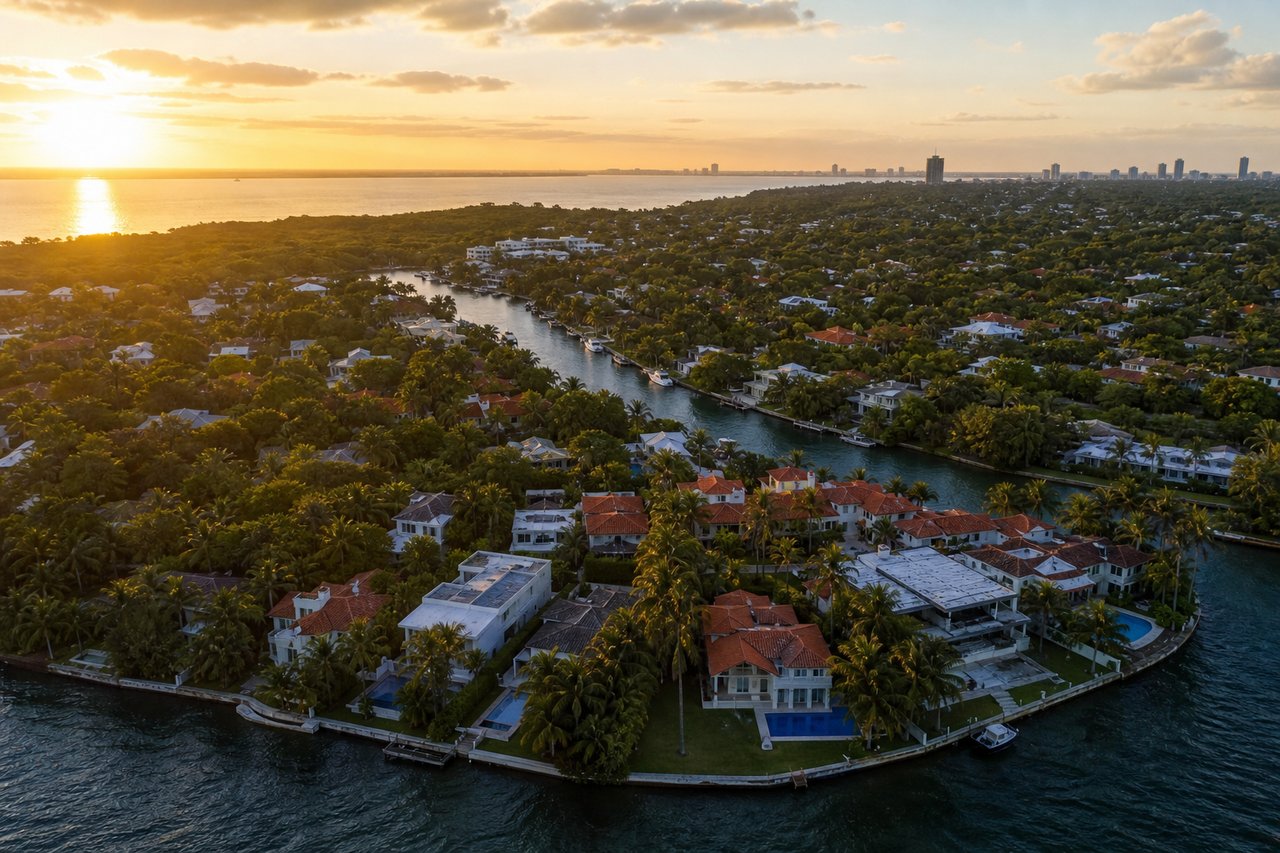
Why is waterfront land in Coral Gables, Coconut Grove, and Key Biscayne so expensive in 2026?
Waterfront estate land in these three neighborhoods commands a premium above and beyond the broader Miami market because supply is structurally capped. All three communities are essentially fully platted and built out, meaning new bayfront parcels only become available through teardowns or redevelopment, not through raw land coming to market. That ceiling on supply, combined with sustained demand from domestic and international buyers, is pushing land values higher even as the wider Miami-Dade single-family market moves toward balance.
Key Takeaways
- Miami-Dade's countywide estimated taxable value reached approximately $540.7 billion in 2026, up roughly 5.5% from 2025, according to the Miami-Dade County Property Appraiser, and coastal municipalities are growing faster than the county average.
- Key Biscayne's single-family median sale price sits at $5,000,000, Coral Gables at $2,500,000, and Coconut Grove at $2,380,000 based on recent MLS single-family data—all well above the general countywide baseline.
- Waterfront estates in Coral Gables, Coconut Grove, and Key Biscayne operate as a micro-market with structurally constrained supply: a handful of listings can meaningfully shift apparent inventory even when the broader county looks balanced.
- Many ultra-luxury waterfront transactions in these neighborhoods trade off-MLS through private networks, making public listing counts an unreliable measure of true scarcity.
- Buyers in these submarkets increasingly approach a purchase as a land play, evaluating seawall condition, view corridors, dock potential, and lot depth rather than the existing structure.
Why are these three neighborhoods different from the rest of Miami-Dade?
The short answer: there is no more land to create. Coral Gables (particularly Gables Estates and Cocoplum), Coconut Grove, and Key Biscayne are all fully platted, largely developed communities. A waterfront estate lot becomes available only when an existing owner sells, and often only when a buyer is willing to purchase the existing home primarily for the land beneath it.
That dynamic is meaningfully different from a market where developers can subdivide raw acreage or where new waterfront communities are being permitted. Here, the supply ceiling is essentially fixed by geography and existing development. Every bayfront lot that trades is one of a finite number that will ever exist.
I work these three markets closely, and the conversations I have with buyers reflect exactly this reality. The question isn't just "what is the house worth", it's "what is this frontage worth, and what can I build here." That land-first mindset is what separates ultra-luxury waterfront buyers from everyone else.
How the county tax base confirms what buyers already know
The Miami-Dade County Property Appraiser reports that the countywide estimated taxable value for 2026 reached approximately $540.7 billion, up 5.5% from 2025. While that 5.5% figure reflects a stabilizing broader market compared to double-digit surges in previous years, coastal municipalities continue to outpace the county average—proving that ultra-luxury waterfront land is decoupling from general market normalization.
The June 1, 2026 estimated taxable values by taxing authority breaks out value growth for coastal municipalities, showing year-over-year increases of 3.9% or more in cities like Miami and Miami Beach. Coral Gables, Coconut Grove, and Key Biscayne, all high concentrations of waterfront and estate-caliber housing, sit within this same coastal appreciation story. The county tax base is a useful proxy for underlying land appreciation, even before layering in the waterfront premium specific to these neighborhoods.
The Property Appraiser's 2025 certification commentary also notes that value increases reflect a long-running trend, not a single-year anomaly, which matters when a buyer asks whether this appreciation is sustainable.
What the broader market data tells you about these submarkets
The June 2026 Miami-Dade single-family market summary shows a countywide single-family baseline median sale price of $1,799,999.50, with closed sales up roughly 16.8% year-over-year and active listings down about 22.7% year-over-year, pointing to a market that is tightening even at the county benchmark level. Months of supply sits at approximately 4.9 months, near balanced-market territory.
Now look at where Coral Gables, Coconut Grove, and Key Biscayne sit relative to that countywide baseline, based on recent local market data:
Submarket / Region | Property Type | Median Sale Price | Median Days on Market |
|---|---|---|---|
Coconut Grove | Single-Family | $2,380,000 | 41 |
Key Biscayne | Single-Family | $5,000,000 | 96 |
Coral Gables | Single-Family | $2,500,000 | 42 |
Miami-Dade County | Single-Family Benchmark | $1,799,999.50 | 55 |
Coral Gables, Coconut Grove, and Key Biscayne all trade at significant premiums over the county single-family baseline. Furthermore, these submarket medians encompass all single-family homes across each zip code—inland and non-waterfront included. The direct bayfront waterfront tier within these neighborhoods trades at a massive premium above even these multi-million-dollar single-family baselines.
What this means if you are buying or selling a waterfront estate
For buyers: think like a land investor
When I work with buyers on waterfront estate acquisitions in these neighborhoods, I encourage them to evaluate the land independently of the structure. What is the linear footage of waterfront? What is the seawall condition? Is there a permitted dock, and if not, can one be added? What are the view corridors, and are they protected? What is the lot depth, and what setbacks apply to new construction?
These questions matter because many buyers in this tier are purchasing with a rebuild or significant renovation in mind. The existing home is often a placeholder. A property that looks overpriced on a price-per-square-foot basis for the existing structure may be entirely reasonable, or even underpriced, when evaluated purely on what the land can support.
The key considerations for waterfront estate buyers across these prime submarkets go well beyond the listing sheet, and I walk every client through them before an offer is written.
One additional factor: many of the most significant waterfront transactions in Coral Gables, Coconut Grove, and Key Biscayne never appear on the MLS. They trade through private networks, off-market introductions, and relationships between agents who specialize in this tier. If you are relying solely on public listing searches to understand what is available, you are seeing an incomplete picture. Your specific opportunity depends on who knows you are looking, and who knows what is quietly available.
For sellers: scarcity is your strongest argument
If you own a waterfront estate in one of these three neighborhoods, the structural supply constraint works in your favor. There is no pipeline of new competing inventory. The next buyer who wants bayfront in Coral Gables, Coconut Grove, or Key Biscayne has to wait for one of a small number of owners to decide to sell.
That said, scarcity alone doesn't mean any price is achievable at any time. Buyer pools at this level are sophisticated, and they will walk from a property that is mispriced or that has deferred maintenance issues that complicate a rebuild or renovation. Timing, presentation, and pricing strategy still matter, and the difference between a property that sells in weeks versus one that sits for a year is almost always the strategy behind the listing, not the asset itself.
Whether 2026 is the right moment for you to list depends on your specific property, your financial picture, and what the private-market demand looks like right now. That's a conversation worth having before you make any decisions. You can read more about why Coral Gables waterfront estate scarcity matters for buyers, and the same dynamics shape what sellers can expect.
For a broader view of how these neighborhoods compare on waterfront lifestyle and investment fundamentals, my overview of Miami's top waterfront luxury neighborhoods covers what sets each one apart.
Frequently Asked Questions
Why are waterfront estates in Coral Gables, Coconut Grove, and Key Biscayne so much more expensive than the rest of Miami?
All three neighborhoods are essentially fully built out, so new bayfront parcels only come to market through teardowns; there is no raw waterfront land left to develop. That structural supply ceiling, combined with consistent demand from domestic and international buyers who treat these properties as safe-haven assets, keeps prices well above county baselines. The countywide single-family baseline sits at $1,799,999.50, while recent single-family MLS data places Coconut Grove at a $2,380,000 median, Coral Gables at $2,500,000, and Key Biscayne at $5,000,000—and trophy waterfront estates within those areas trade at substantial multiples above even those numbers.
Is there really a shortage of direct bayfront homes in Coconut Grove and Key Biscayne, or is that just marketing?
The scarcity is real and structural, not a marketing narrative. Coconut Grove's waterfront is described by those who track it closely as genuinely built out, with no meaningful undeveloped bayfront acreage remaining. Key Biscayne is an island with fixed geography, the number of waterfront lots is physically capped. Beyond that, a significant share of waterfront estate transactions in both neighborhoods trade off-MLS through private channels, so public listing counts routinely understate how little is actually available to buyers who know where to look.
Are waterfront estate prices still rising in 2026, or has the Miami market cooled?
The Miami-Dade County Property Appraiser reports that the countywide estimated taxable value for 2026 reached approximately $540.7 billion, up 5.5% from 2025. While that 5.5% figure reflects a stabilizing broader market compared to double-digit surges in previous years, coastal municipalities continue to outpace the county average—proving that ultra-luxury waterfront land is decoupling from general market normalization.
If there are only a few trophy waterfront parcels left, how does that change my strategy as a buyer?
It means you need to be pre-positioned, not reactive. The most significant waterfront estates in these neighborhoods often trade before they are publicly listed, through agent relationships and private networks. Waiting for a listing to appear on a portal means you are already behind the buyers who have established relationships with agents who specialize in this tier. You also need to evaluate properties on land value first, not on the existing structure, because many of the best acquisitions involve a teardown or major renovation. Working with an agent who has direct access to off-market inventory in these specific neighborhoods is not optional at this level, it is the strategy.
As a seller with a waterfront estate in Coral Gables, should I wait for more appreciation, or is 2026 a good time to list?
That depends on your specific property, your timeline, and what private-market demand looks like for your particular frontage, lot size, and location right now, there is no universal answer. What I can tell you is that the structural scarcity argument is as strong as it has ever been, the tax base data confirms continued appreciation in coastal municipalities, and buyer demand from international markets remains active. The more useful question is whether your property is positioned to capture the right buyer, which is a conversation about pricing strategy and off-market outreach rather than a simple calendar decision.
Waterfront land in Coral Gables, Coconut Grove, and Key Biscayne is one of Miami's most finite assets, and the buyers and sellers who move strategically in this tier are the ones who understand that the real value is in the land, not the structure. If you are weighing a purchase or considering a listing, the numbers and the strategy behind them are worth a direct conversation.
Ready to talk through your waterfront opportunity? Schedule a consultation with me directly and I'll walk you through what the current private-market demand looks like for your specific neighborhood and property type.
Equal Housing Opportunity. Elaine Kauffmann, Broker Associate, MiamiRe. This article is general market information only, not legal, tax, or financial advice. Confirm your specific numbers and transaction details with your real estate attorney, tax advisor, or lender.