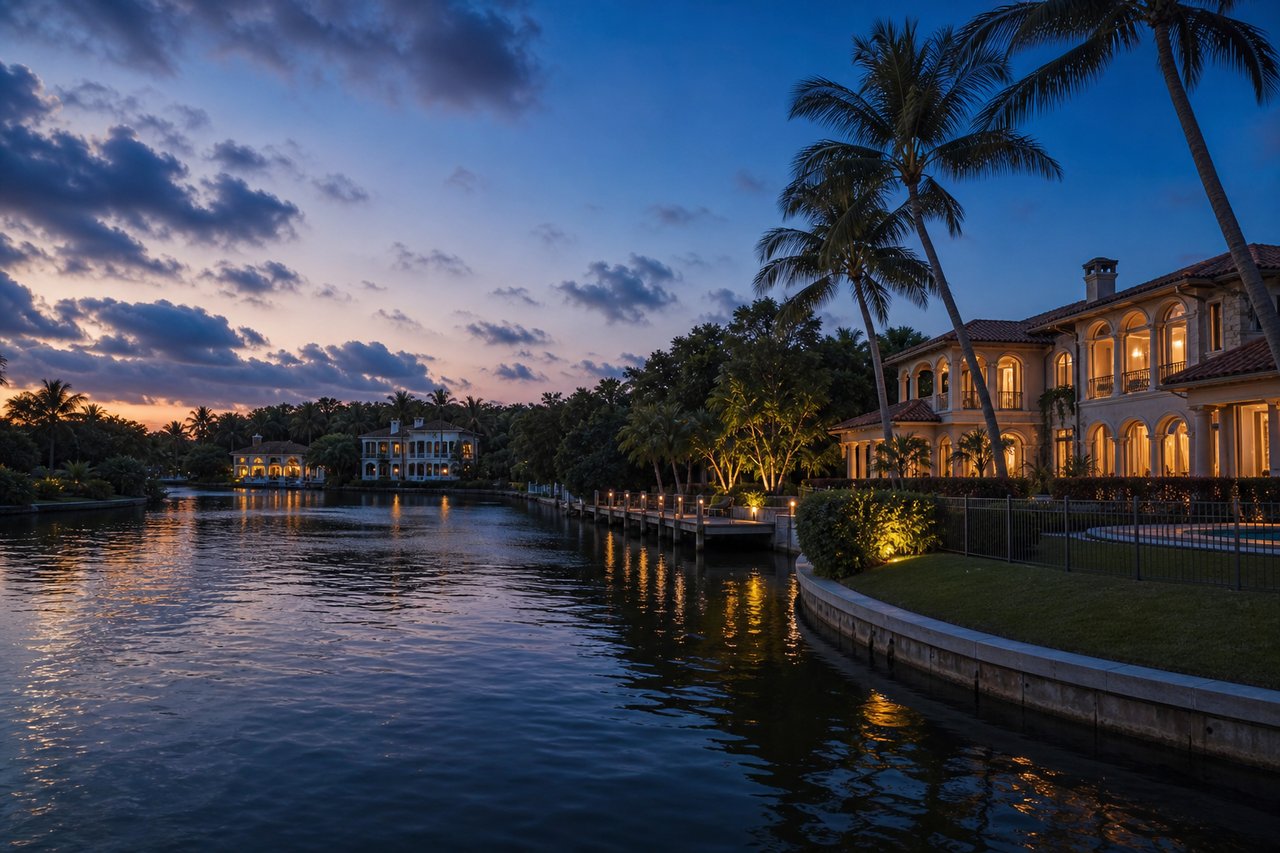
Coral Gables waterfront estates are scarce because the supply is physically finite. The gated enclaves that define this market, primarily Gables Estates and Cocoplum, are fully built out. Every platted waterfront lot already has a home on it, which means new inventory only enters the market when an existing owner decides to sell, often after years or decades of ownership. That structural constraint, combined with Miami's sustained in-migration of high-net-worth households, keeps this segment tightly supply-constrained and price-resilient even when broader real estate markets soften.
What Makes This Market Structurally Different From Other Luxury Real Estate
Most luxury real estate markets have a release valve: developers can build more product. Coral Gables waterfront doesn't work that way. The waterfront lots in communities like Gables Estates and Cocoplum are governed by recorded deed restrictions, HOA covenants, and strict architectural controls that limit what can be built, how it can be used, and how quickly approvals move. That's not a bug, it's the feature. Those same controls are a core reason values hold.
I've worked in this market for 14 years, and one thing I tell every buyer who calls me about Coral Gables waterfront is this: you are not competing with new construction. You are competing with other buyers for a fixed pool of assets, some of which never reach the public MLS at all.
The Enclaves That Define the Market
Three communities anchor the Coral Gables waterfront investment conversation:
Gables Estates: An ultra-luxury, guard-gated community on Biscayne Bay. Every home is waterfront, with either direct bay frontage or yacht-friendly canals. Turnover is exceptionally low, and the architectural review process is rigorous. According to the Gables Estates HOA's community standards, structural changes require association approval before any permits are pulled.
Cocoplum / Islands of Cocoplum: A guard-gated community with a private marina, canal-front and bay-view estates, and strong security infrastructure. The Cocoplum HOA maintains similar controls on renovations, dock configurations, and vessel specifications.
Old Cutler Bay and southern Coral Gables waterfront enclaves: Situated along the city’s southern waterfront corridor, these guard-gated streets offer deep-canal access and direct bay proximity with no fixed bridges. They provide a somewhat wider range of luxury price points than Gables Estates while remaining firmly in the top tier of Coral Gables real estate.
What all three share: finite lots, no new platting, and long average holding periods. Public-record patterns show that top-tier waterfront estates in these communities are often held as primary, trophy, or generational assets, not traded frequently.
What the Data Says About Pricing and Inventory
Granular, real-time MLS data for Coral Gables waterfront is not publicly accessible in a single open feed, but the directional picture from available reports is consistent. Market reports covering Coral Gables and Greater Miami through 2024 and 2025 describe waterfront and ultra-luxury single-family homes in prime Gables neighborhoods trading in the multi-million-dollar range, with a meaningful share of closed sales above eight figures, according to reporting from ONE Sotheby's International Realty's Miami-Dade County Market Reports. The Miami Association of REALTORS® residential market reports for 2024 and 2025 characterize this as a supply-constrained segment, with brokers noting that quality waterfront inventory remains limited and turnover in trophy estates is low.
Nationally, the National Association of REALTORS® has documented continued price resilience in the luxury and waterfront niche even as broader existing-home sales cooled, with waterfront and second-home markets supported by high-net-worth buyers and limited inventory. That national pattern maps directly onto what I see on the ground in Coral Gables.
Community Water Access Type Supply Characteristic Key Scarcity Driver
Gables Estates Bay frontage and yacht canals Fully built out, very low turnover Guard-gated, strict HOA, no new lots
Cocoplum / Islands of Cocoplum Canal-front and bay view, private marina Fully built out, moderate turnover HOA controls, private marina access
Old Cutler Bay / Adjacent CG Streets Deep canals and bay access Established, limited new supply Coastal geography, no new platting
Investment Strategies for Buyers in a Supply-Constrained Market
If you're approaching Coral Gables waterfront as an investment, the scarcity dynamic changes how you need to operate. Here's how I walk serious buyers through it.
Get Off-Market Access or You'll Miss the Best Inventory
In ultra-luxury Coral Gables waterfront, a meaningful share of transactions happen privately, before a property ever reaches the MLS or public marketing. Sellers at this level often prefer discretion. That means the buyer who shows up after a Zillow alert is frequently not the buyer who gets the deal.
The practical implication: you need a broker with active relationships inside these communities, not just MLS access. I maintain ongoing contact with homeowners, estate attorneys, and fellow agents who work these neighborhoods specifically so my clients hear about opportunities before they're public. If you're serious about this market, that network is your most valuable asset. You can read more about how to position yourself in my guide to Coral Gables waterfront estates: key considerations for buyers.
Understand the Value Tiers Before You Make an Offer
Not all waterfront is equal, and the pricing tiers in Coral Gables reflect that precisely. According to Miami Association of REALTORS® commentary and local appraisal firm analysis, waterfront value is driven by a specific hierarchy of factors:
Navigability: Deep-water canals with ocean access command the highest premiums. Shallow or landlocked water views do not.
Frontage and lot size: Wider frontage means more dockage capacity and better view corridors. Corner lots on canal intersections are particularly sought after.
Seawall condition: A failing seawall is not just a repair cost, it's a permitting and regulatory issue. The City of Coral Gables and Miami-Dade County have adopted seawall and shoreline protection ordinances, including minimum height and maintenance standards in certain areas, per the City of Coral Gables and Miami-Dade County. Budget for a seawall engineer as part of due diligence, not as an afterthought.
Orientation: Open bay versus canal, sunset versus sunrise exposure, and unobstructed view corridors all affect both livability and resale value.
Dockage configuration: Slip capacity, lift installations, and HOA rules on vessel type and size all affect how usable the waterfront actually is.
For a deeper dive on dockage specifics, my Coral Gables waterfront buying guide on dockage essentials walks through what to evaluate before you commit.
The Under-Improved Lot Strategy
One of the more compelling opportunities I see in this market right now: older homes sitting on premium waterfront lots where the land value substantially exceeds the structure value. A 1970s-era house on a wide bay-front lot in Gables Estates may be worth acquiring for teardown and new construction, unlocking a modern estate at a total cost that still represents a discount to comparable finished product.
This strategy works, but it requires careful coordination with city permitting, the HOA architectural review committee, seawall and dock contractors, and potentially environmental consultants. The timeline from acquisition to certificate of occupancy on a ground-up waterfront estate in Coral Gables is not short. Plan accordingly.
Demand Drivers That Support Long-Term Value
The structural case for Coral Gables waterfront as a long-term hold rests on several converging factors:
In-migration of high-income households: The Beacon Council, Miami-Dade's economic development organization, has documented continued relocation of finance, tech, and professional-services firms from other states through 2024 and 2025, sustaining luxury home demand at the top of the market.
Florida's tax environment: The Florida Department of Revenue confirms Florida has no state income tax, and Florida's homestead protections are a structural attractor for affluent buyers establishing primary or seasonal residences. Wealth managers consistently cite these as reasons clients choose Miami over comparable markets in other states.
International demand: Miami's position as a gateway city for Latin American and European capital means Coral Gables waterfront competes in a global buyer pool, not just a domestic one. That international demand base is a meaningful buffer against purely domestic economic cycles.
Inelastic supply: National research from the NAR and the Urban Land Institute consistently shows that waterfront properties tend to retain value better and recover faster after downturns than non-waterfront properties, largely because shoreline is finite.
Due Diligence Is Not Optional at This Price Point
Every waterfront estate transaction I've been involved in at this level has required more due diligence than a standard residential deal, not less. Here's what I walk my clients through as non-negotiables:
Survey and elevation certificate: Critical for confirming boundaries, dock placement, encroachments, and flood-risk exposure. Many waterfront lots have recorded easements along the shoreline that affect what you can build.
Permitting history: Miami-Dade and Coral Gables permit databases are checked for seawall, dock, pool, and renovation permits, including whether work was properly closed out. Unpermitted improvements on a waterfront property are a serious problem at resale.
Flood zone status: Many Coral Gables waterfront estates fall within FEMA Special Flood Hazard Areas, which affects flood insurance requirements when financing with a federally regulated lender. Elevation, seawall integrity, and drainage are material underwriting factors.
HOA governing documents: In Gables Estates and Cocoplum, recorded deed restrictions and HOA covenants govern permissible uses, renovations, dock configurations, and sometimes vessel specifications. These documents are delivered during due diligence and must be reviewed carefully, ideally with an attorney.
Seller Property Disclosure: Florida imposes a legal duty to disclose known latent material defects under case law, per the Florida Bar and NAR's consumer guide on seller disclosures. For waterfront estates, that disclosure should specifically address seawall condition and repairs, dock construction and permits, flooding or storm surge history, and any known HOA violations or pending assessments. Florida Realtors® provides standard disclosure forms widely used in the Miami market, per Florida Realtors®, but the legal duty exists regardless of which form is used.
Attorney Involvement: Not a Luxury, a Necessity
Florida does not require a real estate attorney at closing by statute, but in a Coral Gables waterfront transaction, retaining one is standard practice, not optional. These deals routinely involve entity structuring (LLCs, trusts), cross-border buyer considerations, bespoke contract riders for seawall inspections and zoning verifications, and title review of recorded easements and HOA covenants. The Florida Bar's consumer guide on buying a home outlines the role of attorneys in complex transactions. At eight or nine figures, the cost of an attorney is not the issue. The cost of missing something in the title commitment or HOA documents is.
A Note on Closing Costs and the Documentary Stamp Tax
Florida imposes a Documentary Stamp Tax on deeds at a statutory rate set by the Florida Department of Revenue. The rate itself is fixed by state statute; it is not negotiable. Who pays it in a given transaction, however, is a matter of contract between buyer and seller. Florida Realtors® notes that local custom in many Florida markets, including Miami, has historically allocated this cost to the seller, but that custom is not required by law and can be negotiated differently, particularly in transactions where one party has greater leverage. For any eight-figure waterfront estate, I strongly recommend confirming the allocation explicitly in the contract and verifying the full picture of closing cost categories with your attorney, tax advisor, and closing officer. The categories involved, including title insurance, survey costs, HOA transfer fees, recording fees, and waterfront-specific inspections, vary by transaction and are not something to estimate from a blog post. Your specific numbers depend on your deal structure, and that's a conversation worth having before you go under contract.
Beyond the Documentary Stamp Tax, buyers assembling portfolios or contemplating entity restructurings should work with a tax advisor to understand when deed transfers trigger tax obligations, per guidance from the Florida Department of Revenue and The Florida Bar's estate planning resources.
Frequently Asked Questions
How scarce are true waterfront estates in Coral Gables, and which neighborhoods have the most limited supply?
Supply is genuinely tight. The primary waterfront enclaves, Gables Estates and Cocoplum, are fully built out with no new lots being platted. New inventory enters only when an existing owner sells, and holding periods in these communities tend to be long. Gables Estates has the most constrained supply of any Coral Gables waterfront enclave, given its all-waterfront configuration and strict HOA controls. Cocoplum and adjacent Old Cutler Bay streets offer somewhat more turnover but remain limited relative to buyer demand.
What makes Gables Estates and Cocoplum waterfront homes more valuable than non-waterfront Coral Gables properties?
Several factors stack on top of each other: navigable water access (deep canals and bay frontage that accommodate large vessels), lot size and frontage, guard-gated security, private marina access in Cocoplum, and strict architectural controls that protect the character and exclusivity of the community. The Miami Association of REALTORS® and local appraisal commentary consistently note that true waterfront estates with navigable ocean access command substantial premiums over non-waterfront properties, with further tiers based on seawall condition, dockage, and view corridor.
If inventory is this tight, how can a buyer actually find and secure a Coral Gables waterfront estate before it hits the market?
The short answer: you need a broker with active relationships inside these communities. A meaningful share of Coral Gables waterfront transactions happen off-market or semi-privately, before any public listing. Sellers at this level often prefer discretion and will transact with a known buyer through a trusted agent rather than running a public marketing campaign. Showing up after a Zillow alert is rarely how these deals get done. The right broker gives you access to that pipeline.
How do flood zones, seawall rules, and climate risk affect the long-term value of a Coral Gables waterfront investment?
Many Coral Gables waterfront estates fall within FEMA Special Flood Hazard Areas, which affects flood insurance requirements and underwriting, per the FEMA Flood Map Service Center. The City of Coral Gables and Miami-Dade County have adopted seawall and shoreline protection ordinances that set minimum standards for maintenance and height in certain areas. At the same time, national research from the Urban Land Institute and academic institutions like the Wharton/Zell-Lurie Real Estate Center suggests that premium, well-located waterfront markets with strong local economies and active resilience investment continue to attract global capital, even as lower-lying coastal areas face emerging climate discounts. Elevation, seawall integrity, and drainage are material factors in both underwriting and long-term valuation, and buyers should evaluate them proactively as part of due diligence.
Do I really need a real estate attorney when buying a high-end waterfront estate in Coral Gables?
Yes, in practice. Florida doesn't mandate attorney involvement at closing by statute, but waterfront estate transactions at this price point routinely involve entity structuring, cross-border buyer issues, title review of recorded shoreline easements and HOA covenants, and bespoke contract riders for seawall and dock inspections. The Florida Bar's consumer materials on buying a home strongly recommend attorney involvement in complex transactions. At eight or nine figures, the cost of missing something in the title commitment or HOA documents far exceeds the cost of legal counsel.
What has to be included in the Seller Property Disclosure for a Coral Gables waterfront home?
Florida's legal baseline, established under case law rather than a single mandated form, requires sellers to disclose known latent material defects that are not readily observable to a buyer, per NAR's consumer guide on seller disclosures and Florida Bar materials. For a waterfront estate, that means the disclosure should specifically address seawall condition and any known repairs or erosion, dock construction and permitting status, any history of flooding or storm surge (including past insurance claims), boat restrictions under HOA rules, and flood-zone status. Florida Realtors® provides standard disclosure forms widely used in the Miami market, but the duty to disclose exists regardless of which form is used, and sellers must update disclosures if new material defects come to light before closing.
The Bottom Line
Coral Gables waterfront estates represent one of the most structurally scarce luxury asset classes in South Florida. Finite lots, long holding periods, high barriers to entry, and sustained demand from a global buyer pool make this a segment where the fundamentals favor patient, well-positioned buyers. The challenge is access and execution, not the investment thesis.
If you're serious about acquiring a waterfront estate in Coral Gables, the next step is a direct conversation, not more online research. I know which properties are quietly available, which lots represent the best redevelopment opportunity, and how to structure an offer that gets taken seriously in this market. Schedule a consultation and let's talk about what's actually possible for your situation.
About Elaine Kauffmann
Elaine Kauffmann is a top 1% Miami-Dade luxury real estate broker with over $100M in career sales and 14 years of experience specializing in ultra-luxury homes, waterfront estates, and new developments across Coral Gables, Coconut Grove, Miami, Key Biscayne, and Miami Beach. Ranked among Compass's Top 100 Agents and featured in Mansion Global and Real Trends, she represents high-net-worth buyers and sellers seeking exceptional properties and investment opportunities in Miami's most prestigious neighborhoods.
Compass · 7864773500
Equal Housing Opportunity. Elaine Kauffmann is a licensed Broker Associate regulated by the Miami Association of REALTORS® (MiamiRE). This article is provided for general informational purposes only and does not constitute legal, tax, or financial advice. Readers should confirm their own costs, tax obligations, and transaction details with their attorney, tax advisor, lender, or escrow/closing officer.