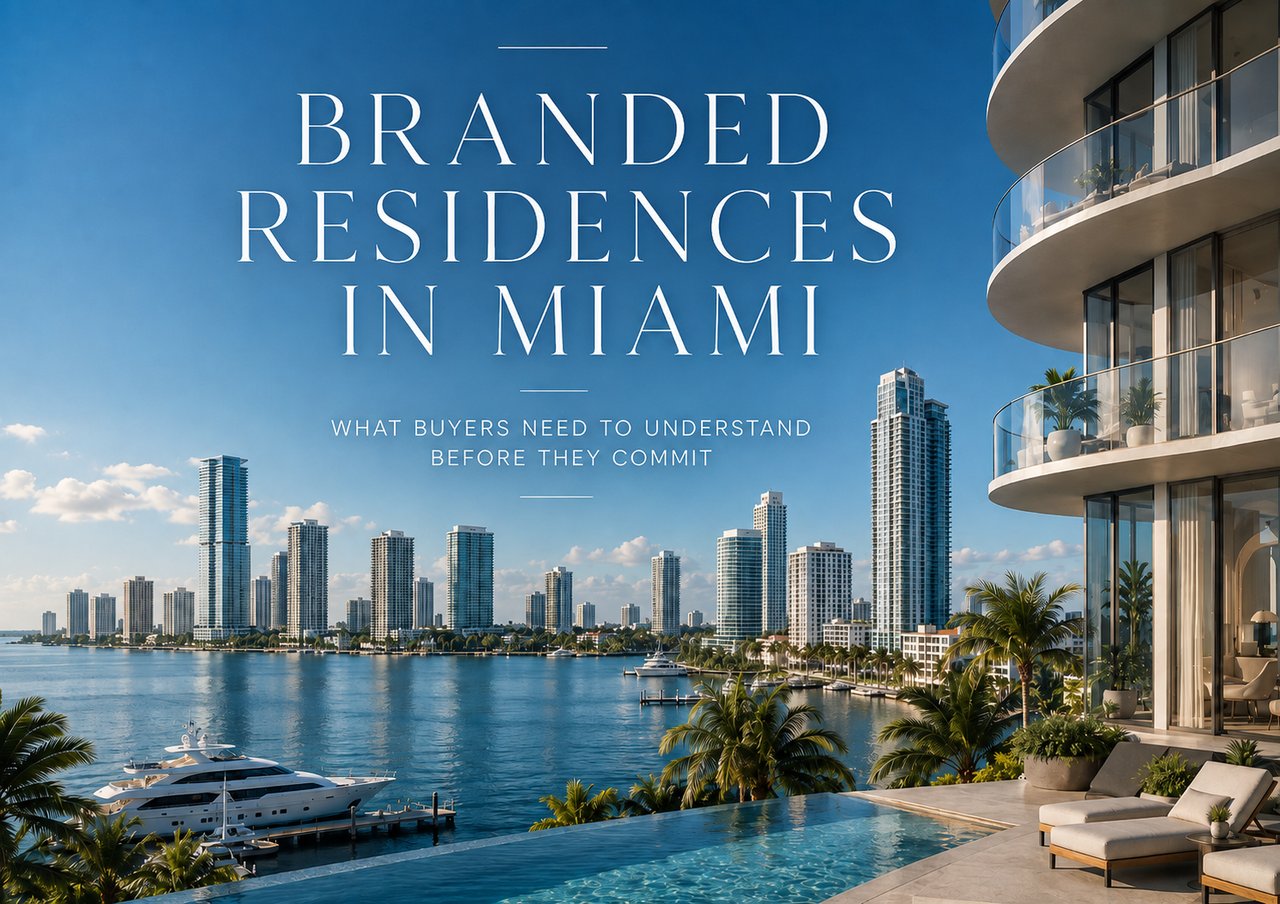
A branded residence is a private condominium developed in partnership with a luxury brand, hotel group, automotive marque, or fashion house that lends its design standards, service infrastructure, and name to the building. According to The Design Courier's coverage of Savills' Branded Residences Report 2024, global branded residences have grown by more than 180% over the past decade, and the pipeline is expected to nearly double existing supply by 2032. Miami sits at the center of that story: Savills ranks Miami second in the world after Dubai for the number of branded residence projects in its pipeline as of 2025.
For buyers I work with across Brickell, Edgewater, and the broader Miami market, the question isn't whether branded residences are worth considering. It's whether you understand exactly what you're buying, and what questions to ask before you sign anything.
What makes Miami's branded residences different from other luxury condos
The short answer: a combination of design, service, and brand-enforced standards that a typical luxury tower can't replicate on its own.
In a hospitality-branded building like St. Regis or Waldorf Astoria, you get butler service, concierge, and hotel-style amenities managed to the brand's global standards. In an automotive-branded building like Bentley or Aston Martin, the emphasis shifts to bespoke interior packages, design language pulled directly from the marque's vehicles, and a lifestyle identity that appeals to a specific kind of buyer. Both models deliver something a generic luxury tower doesn't: a consistent, internationally recognized standard that travels with the property at resale.
That consistency has a measurable dollar value. According to Savills' branded residences research, established hospitality-branded residences in Miami can command an approximate 32% premium over comparable non-branded units, second only to Dubai's 38%. For investors, branded units in established Miami submarkets have generally shown stronger resale performance than comparable non-branded condos in the same buildings, though yield and appreciation vary significantly by project, brand, and management quality. Those are meaningful numbers, but they reflect established, well-managed projects, not every building that puts a logo on the lobby.
The projects reshaping Miami right now
CoStar reported that 2024 became South Florida's "year of the branded condo," with over a dozen new branded projects announced in a single year—including Mercedes-Benz Places, Pagani Residences, Jean-Georges Miami Tropic Residences, Dolce & Gabbana, and several hotel-branded towers. The post-pandemic influx of high-net-worth buyers into Miami drove developers to compete on brand identity rather than just square footage or floor height.
Here are the projects I'm most frequently asked about, and where each stands as of August 2026:
Aston Martin Residences (Downtown Miami / Brickell bayfront): Completed and delivered. The building brought the British marque's design philosophy—complete with fluid forms, hand-selected materials, and automotive-grade finishes—into a residential tower on Biscayne Bay.
Waldorf Astoria Residences Miami (Downtown supertall): Under construction as of August 2026. According to Miami Condo HQ's August 2026 project status table, the tower will include 360 branded residences. Reaching 1,049 feet, it will be Florida's tallest building and South Florida's first supertall skyscraper when complete.
St. Regis Residences Miami (Brickell): Under construction, with approximately 152 residences, per updated project specifications. This is a standalone residential project, no hotel component, which means owners get St. Regis service standards without the operational dynamics of a condo-hotel.
St. Regis Bal Harbour: The established benchmark. Completed in 2012, this 268-residence complex adjacent to Bal Harbour Shops has operated as a condo-hotel for over a decade and remains one of the most referenced comps in the branded segment.
Bentley Residences (Sunny Isles Beach): A 62-story, roughly 749-foot tower, the first residential building for Bentley Motors, with 216 residences and only four units per floor.
The Condo Black Book Q4 2025 and annual Miami luxury condo market summary, published in February 2026 and the most recent full-year summary available as of August 2026, noted record annual price levels for luxury condos in 2025, while also characterizing the broader market as a buyer's market. That combination matters: prices are high, but negotiating room exists in certain segments. Branded residences, particularly pre-construction, operate under a different dynamic—developers rarely discount, but the terms, deposits, and upgrade packages can be structured thoughtfully with the right representation.
Location shapes the lifestyle, not just the address
Downtown and Brickell put you in the middle of Miami's financial and cultural core, walkable to restaurants, close to the water, with easy access to the airport and the Design District. Sunny Isles Beach is a quieter, ocean-facing corridor that draws buyers who want a more resort-like daily experience. Bal Harbour sits between the two, with the draw of one of the country's most prestigious retail destinations directly adjacent.
None of these locations is objectively better. The right one depends on how you plan to use the property, primary residence, seasonal home, or investment, and that's a conversation worth having before you tour a single unit.
What buyers need to understand before they commit
Branded residences introduce a layer of legal and financial complexity that standard luxury condos don't carry. Here's what I walk every client through before they go under contract.
Read the brand agreement, not just the floor plan
Every branded building operates under a license agreement between the developer (and eventually the condominium association) and the brand. That agreement governs finish standards, staffing levels, service requirements, and, critically, what happens if the brand relationship ends. I strongly recommend engaging a Florida real estate attorney to review:
The duration of the brand agreement and any renewal or termination provisions
Fees payable to the brand or its management entity
Your obligations as an owner if the branding agreement changes or lapses
Use restrictions, rental rules, and any hotel-program participation requirements
Florida does not legally require a buyer to use an attorney to close a residential transaction, closings here are typically handled by title companies. But for a pre-construction branded residence with a developer contract, association documents, and a brand management agreement all running simultaneously, an attorney isn't optional in my view. It's the difference between knowing what you own and assuming you do.
Pre-construction vs. completed: two very different purchases
Buying into a project like Waldorf Astoria Residences or St. Regis Brickell while it's under construction—with target delivery timelines extending into 2027 and 2028—means you're committing based on renderings, model units, and a developer's track record. Construction timelines shift. Delivery dates move. The unit you tour in a sales gallery is not the unit you'll close on; the finishes may be representative, but the actual space won't exist until it does.
My Miami pre-construction condo buyer's guide covers the deposit structure, contract review process, and timeline risk in detail. For branded projects specifically, I'd add one more layer: understand who the developer is, not just who the brand is. The brand licenses its name; the developer builds the building and manages your money during construction.
Association dues and operating costs reflect the service level
Hotel-branded buildings like St. Regis and Waldorf Astoria carry the staffing and operational costs of a five-star hotel embedded in their association structures. Automotive-branded buildings like Bentley and Aston Martin emphasize design and curated amenities rather than a full hotel service stack, which can mean a different cost profile. Neither is inherently better or worse; they're different products for different priorities. What matters is that you understand what you're paying for before you close, not after your first monthly statement arrives.
Your specific cost picture depends on the building, the unit, and the association's current budget—that's exactly the kind of analysis I run for clients before they make an offer.
Branded Residences: Miami Market at a Glance
For context on where branded projects sit relative to the broader Miami condo market, here are current area-level medians based on MLS data (trailing approximately 90 days, as of August 2026). These are area-level figures, an individual branded residence will vary significantly based on building, floor, views, and finishes.
Branded residences in Brickell, where St. Regis and Aston Martin are positioned, trade well above the area median, which reflects the ultra-luxury tier these buildings occupy. The area median is useful for understanding the broader market backdrop, not for pricing a specific branded unit.
Frequently Asked Questions
What exactly is a branded residence in Miami, and how is it different from a regular luxury condo?
A branded residence is a private condo developed in formal partnership with a luxury brand, a hotel group, an automotive company, or a fashion house, that applies its design standards, service model, and name to the building. Unlike a high-end condo that simply markets itself as luxury, a branded residence is contractually tied to a specific brand's quality benchmarks and service infrastructure. In Miami, that means everything from Bentley-designed interiors in Sunny Isles Beach to St. Regis butler service in Brickell.
Are branded condos like Aston Martin Residences or Bentley Residences really worth the premium?
The data suggests yes, for the right buyer and the right project. Savills' research puts Miami's branded premium at roughly 32%, and branded inventory has consistently outperformed non-branded comparables at resale — though that premium isn't automatic. It reflects well-managed buildings with active brand agreements and strong demand.
What should I know about buying a pre-construction branded residence versus a completed one?
Pre-construction means you're buying based on plans, renderings, and a developer's track record, not a finished product you can inspect. You'll sign a developer contract with milestone deposits, accept construction-timeline risk, and rely on the brand agreement holding through delivery. Completed buildings like Aston Martin Residences allow you to see exactly what you're buying, review actual association financials, and close without construction risk. Both have merit depending on your timeline and risk tolerance; the key is understanding the difference before you commit.
Do branded residences in Miami hold their value better at resale?
Based on available data, established branded residences have generally shown stronger resale performance than comparable non-branded condos. That said, resale performance depends heavily on the health of the brand relationship, the building's management quality, and broader market conditions — it's not guaranteed by the logo alone.
Is there a meaningful difference between hotel-branded and automotive-branded residences for day-to-day living?
Yes. Living in a hotel-branded building like St. Regis or Waldorf Astoria feels closer to residing in a five-star hotel, with daily service as the throughline. Living in an automotive-branded building like Bentley or Aston Martin feels more like living inside a piece of design — service is present, but the identity is aesthetic first. If daily service is your priority, hotel-branded is typically the stronger fit; if design and exclusivity are the draw, automotive-branded delivers something distinct.
How does location affect the lifestyle and investment case for branded residences in Miami?
Significantly. Downtown and Brickell offer urban density, and proximity to Miami's business and cultural core — Aston Martin Residences and Waldorf Astoria are positioned here. Sunny Isles Beach, home to Bentley Residences, offers a more resort-oriented, oceanfront experience with less urban intensity. Bal Harbour, home to the established St. Regis Bal Harbour, sits adjacent to one of the country's premier luxury retail corridors. Each location suits a different use case — the right fit depends on your goals for the property.
Miami's branded residence market is one of the most dynamic segments in global luxury real estate right now, and navigating it well requires more than a floor plan and a brand name. The legal structure, the developer's track record, the brand agreement's terms, and the building's operational model all shape what you actually own, and what it's worth when you're ready to sell.
I've worked with buyers across every major branded project in Miami, from pre-construction contracts to completed resales. If you're evaluating a branded residence, or trying to decide whether one is the right fit for your goals, I'd welcome the conversation. Schedule a consultation here and let's work through the specifics together.
About Elaine Kauffmann
Elaine Kauffmann is a top 1% Miami-Dade luxury real estate broker with over $100M in career sales and 14 years of experience specializing in ultra-luxury homes, waterfront estates, and new developments across Coral Gables, Coconut Grove, Miami, Key Biscayne, and Miami Beach. Ranked among Compass's Top 100 Agents and featured in Mansion Global and Real Trends, she represents high-net-worth buyers and sellers seeking exceptional properties and investment opportunities in Miami's most prestigious neighborhoods.
Compass · 7864773500
Equal Housing Opportunity. Elaine Kauffmann, Broker Associate, licensed in Florida. Brokerage: Compass. This article is provided for general informational purposes only and does not constitute legal, tax, or financial advice. Market data and project details are subject to change; verify all figures and terms with your attorney, tax advisor, lender, or closing officer before making any real estate decision.