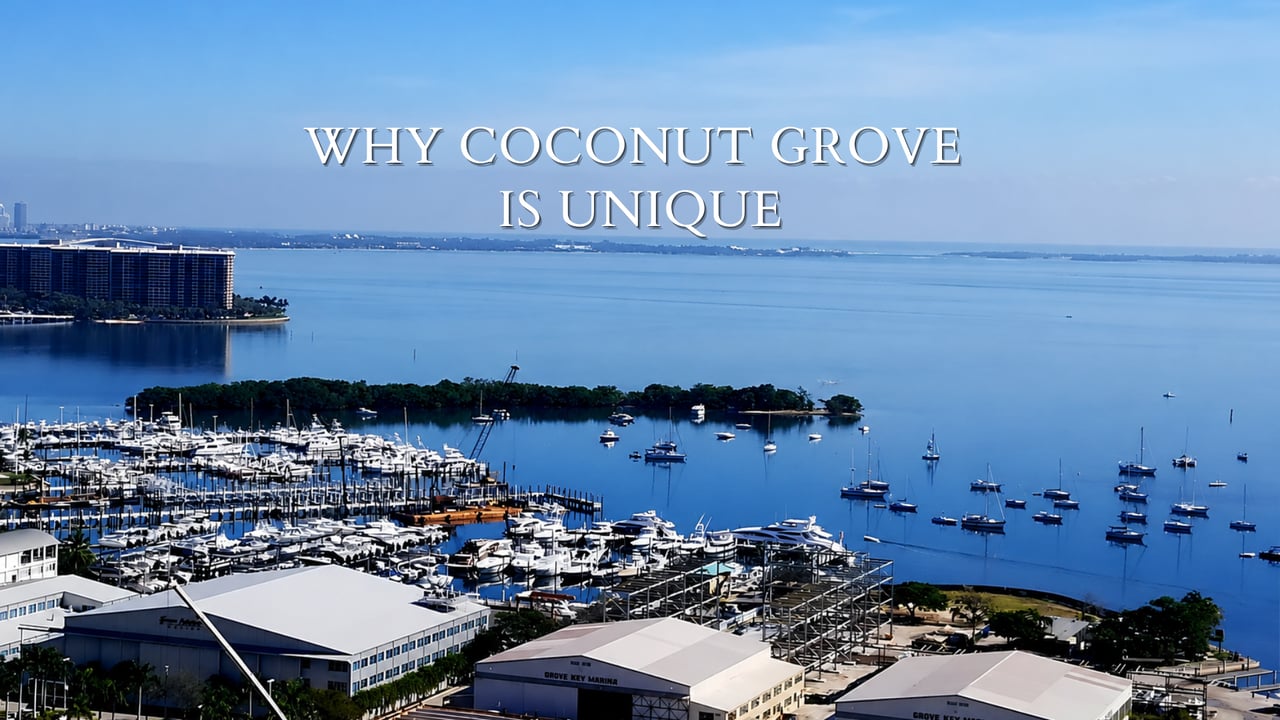
Coconut Grove has never tried to be anything other than itself. While the rest of Miami reinvents its identity every decade, this neighborhood has held its ground. Tree-lined streets, bay access, a genuine arts community, and a quiet confidence that comes from being one of Miami's oldest continuously inhabited neighborhoods, the Coconut Grove neighborhood Miami buyers discover on the ground is unlike anything else in South Florida. That combination of deep roots and serious real estate wealth makes choosing to live here a statement about what you actually value.
This guide covers everything a serious buyer or renter needs to know before making a decision: the neighborhood's character, lifestyle, school quality, dining scene, safety trends, and what the luxury real estate market looks like right now in 2026. By the end, you'll know whether The Grove is the right fit, or the wrong one.
What makes Coconut Grove feel different from the rest of Miami
Miami's oldest neighborhood and its bohemian roots
Coconut Grove predates the city of Miami itself, which is the clearest explanation for why its identity is so firmly established. Bahamian settlers arrived in the late 19th century, followed by an early arts community that gave the neighborhood its creative DNA. That history is not just reputation, it's visible in the architecture, the scale of the streets, and the way the neighborhood has largely resisted the glass-and-steel development that transformed so much of Miami. The result is a place where artists, executives, and multigenerational families coexist without friction, something that doesn't happen by accident.
The bohemian character here is understated rather than performed. You won't find it in branding or marketing language; you'll find it in the independent galleries, the waterfront dinners, and the fact that some of the most expensive estates in The Grove sit on quiet, shaded streets that don't announce themselves at all.
The tree canopy, village streets, and the atmosphere they create
The physical environment is Coconut Grove's clearest differentiator. Dense tropical foliage, winding roads, low-rise buildings, and a walkable commercial core around CocoWalk and Grand Avenue create a texture that simply doesn't exist anywhere else in Miami. Where the rest of the city tends toward skylines and highway access, The Grove rewards pedestrian life. That physical character attracts a specific type of buyer: someone who wants Miami's energy with significantly less of its noise.
The neighborhood's ZIP code is primarily 33133, with some overlap into 33129 depending on the sub-area. Buyers often arrive expecting a boutique enclave and are surprised to discover how much exists within walking distance of any residential street, parks, restaurants, galleries, and direct water access all within easy reach.
Waterfront parks, outdoor life, and the events that define The Grove
Peacock Park, Regatta Park, and bay access
Few Miami neighborhoods offer this concentration of walkable, green, waterfront space. Peacock Park serves as the neighborhood's central gathering point, with bay views, playgrounds, open fields, and a steady rotation of community events. Regatta Park, beside Dinner Key Marina, is the waterfront hub for larger events and has a boat ramp with direct Biscayne Bay access. David T. Kennedy Park draws trail runners and families with its bayfront paths, while The Barnacle Historic State Park offers a rare combination of historic architecture and genuine waterfront grounds in the same footprint.
For buyers who prioritize daily outdoor access, this matters more than any amenity list in a condo brochure. The bay isn't a backdrop in Coconut Grove, it's part of the daily routine.
The annual events that make the calendar worth watching
The Coconut Grove Arts Festival, held over Presidents' Day weekend each February at Regatta Park, is one of the region's longest-running and highest-attendance arts festivals and a genuine cultural anchor. The King Mango Strut parade in December has run for decades as a satirical community tradition. June brings the Goombay Festival on Grand Avenue, celebrating the neighborhood's Bahamian heritage directly. Miami Sailing Week, including the Bacardi Cup regattas, rounds out a calendar that reflects a community with real identity rather than manufactured programming.
These events are worth noting for buyers weighing long-term lifestyle considerations: they draw residents, not just tourists, because they are rooted in the neighborhood's actual history.
Where to eat, drink, and spend a weekend in the Coconut Grove neighborhood
The dining scene: from waterfront spots to neighborhood staples
The food scene in Coconut Grove favors quality over quantity, which matches the neighborhood's character precisely. Ariete consistently ranks as the top-rated restaurant in the area, with the cuisine and atmosphere to justify the reputation. Carbone Vino and Amal Miami anchor the upscale end, while Los Félix brings Michelin-recognized quality to a more neighborhood-casual format. AVA MediterrAegean, KOKO, and Level 6 Rooftop round out a dining scene that offers real range without defaulting to chains or hotel restaurants.
The outdoor dining culture here is a genuine lifestyle perk. With the right table and the right evening, dinner in The Grove feels closer to a Mediterranean coastal village than a major American city, and that's not a marketing line. It's the reason this neighborhood retains residents who could afford to live anywhere.
Arts, nightlife, and the creative community
The Grove's nightlife is low-key by design, and that is the correct design choice for the people who live here. Independent galleries, boutique shopping, and a gallery-opening social circuit replace the bottle-service crowds you'd find in South Beach or Brickell. This distinction matters for buyers thinking seriously about where they want to spend their time: Coconut Grove attracts people who prefer a waterfront dinner or an art opening to a loud club, and the neighborhood's geography and culture actively reinforce that preference. If a dense nightlife scene is on your checklist, The Grove will disappoint. If it's not, The Grove will likely exceed your expectations.
Schools, safety, and the practical realities of living here
Public and private school options for families
The school profile in Coconut Grove is a primary driver for relocating families, and for good reason. Coconut Grove Elementary holds a 10/10 GreatSchools rating, placing it in the top 5% in Florida, with approximately 85% reading proficiency and 83% math proficiency. George Washington Carver Middle School is also highly rated on GreatSchools; prospective families should verify the current rating directly at greatschools.org, as scores are updated periodically. For families considering private options, Carrollton School of the Sacred Heart (PreK–12) and Ransom Everglades School (grades 6–12) are both within the neighborhood, and Mater Grove Academy offers a strong A-rated charter alternative at the K–8 level.
For buyers relocating from markets with less consistent public school quality, this combination of top-rated public and respected private options in the same neighborhood is genuinely rare. It's one of the clearest arguments for The Grove over other Miami luxury submarkets.
Safety trends and commute realities
Crime in Coconut Grove was down 33% year-over-year through mid-2025, with 180 reported incidents compared to 269 in the prior year. The most common incidents are property crimes, car break-ins, retail theft, and larceny, rather than violent crime. Safety profiles vary between sub-areas, with North Grove and South Grove showing different patterns, so sub-neighborhood selection matters here as it does everywhere in Miami.
On commute: Brickell is roughly 10 to 15 minutes by car under typical daytime conditions, though travel times vary meaningfully with traffic. Downtown Miami is similarly accessible. The neighborhood is directly connected via the Coconut Grove Metrorail Station (with nearby stops at Douglas Road and Vizcaya) and local trolley routes, though car ownership remains practical for most residents. Buyers arriving from transit-dense markets should weigh this balance honestly before committing.
Coconut Grove luxury real estate: what the market looks like in 2026
Prices, inventory, and what buyers are competing for
The median home sale price in Coconut Grove sits at approximately $2.85M based on the most recent 90-day MLS data, with single-family homes in certain segments reaching $3.1M to $3.39M. The rental market reflects consistent demand: median rent runs $6,400 per month. As of mid-August 2026, approximately 140 single-family homes and townhomes are active on the market alongside 114 condo listings, for a total of roughly 254 active listings. Higher-end single-family homes in the $3M to $6M range are averaging about 55 days on market, with luxury condos tracking closer to 63 days.
New luxury development is actively reshaping the upper end of the Coconut Grove real estate market. OPUS Coconut Grove, which broke ground in 2026, targets a 2027 completion. Ziggurat Coconut Grove, an 18-residence ultra-luxury project by Oppenheim Architecture, followed in February 2026. The Four Seasons Private Residences began construction in late 2025, targeting delivery in 2027–2028, while THE WELL Coconut Grove, a wellness-branded development, broke ground in January 2026 with a 2028 completion window. New ultra-luxury product is pushing pricing into the $3,000 to $4,000-plus per square foot range at the top end, while the neighborhood median holds around $1,219 per square foot for single-family homes.
Sub-neighborhood nuances and the case for using a local specialist
North Grove, Center Grove, and South Grove each carry distinct character, price points, and buyer profiles. South Grove holds iconic waterfront enclaves like The Moorings (43 homes with direct bay access) and Hughes Cove (an ultra-exclusive gated community of 10 estates). In North Grove, boutique gated enclaves like Treasure Trove (10 luxury homes off South Bayshore Drive across from the yacht club corridor) and Bay Heights (a secure community of 56 homes on seven tree-lined streets) offer exceptional privacy. North Grove's updated interior streets in the $2M to $5M range represent the most active opportunity segment right now, with strong demand and limited supply.
Getting this distinction right matters more than most buyers anticipate. The streets you choose in Coconut Grove determine your commute time, your walkability, and your long-term appreciation trajectory. Elaine Kauffmann, Luxury Real Estate Miami brings sub-neighborhood-level fluency to every client engagement, the kind of on-the-ground knowledge that broad Miami market experience alone cannot replace. Her background in art and media means she understands not just the numbers but the narrative of each enclave, which translates directly into sharper buyer guidance and stronger seller positioning.
Is Coconut Grove the right fit for you?
Who The Grove is built for
Coconut Grove rewards buyers who prioritize character, outdoor lifestyle, school quality, and long-term appreciation over visibility and flash. It photographs best from the street, on foot, under a canopy of ficus trees, not from a drone. That distinction tells you a great deal about the people who choose it. Families wanting top-rated schools and daily park access, buyers leaving condo-heavy neighborhoods in search of land and privacy, creatives and executives who want a neighborhood with genuine roots: these are the people who thrive here and rarely leave.
Buyers who want walkable nightlife density, easy public transit, or a pipeline of new glass towers will find better matches in Brickell or Edgewater. The Grove is a deliberate choice, not a default.
Next steps if you're seriously considering a move
If the Coconut Grove neighborhood Miami has on offer is a serious contender for your next home, the most valuable move is a guided visit with someone who can show you the streets that don't surface on listing portals and walk you through the sub-neighborhood differences that change the value calculation entirely. A properly curated look at The Moorings versus Bay Heights versus a well-positioned North Grove street is worth more than hours of online research.
Elaine Kauffmann, Luxury Real Estate Miami offers exactly that kind of bespoke, white-glove advisory for buyers in the $2M-plus range across The Grove and Miami's other premier neighborhoods. Reach out directly to arrange a private consultation and a curated walkthrough of what's available in The Grove right now. The neighborhood earns its reputation on the ground, and the right guide makes all the difference in finding where within it you actually belong.