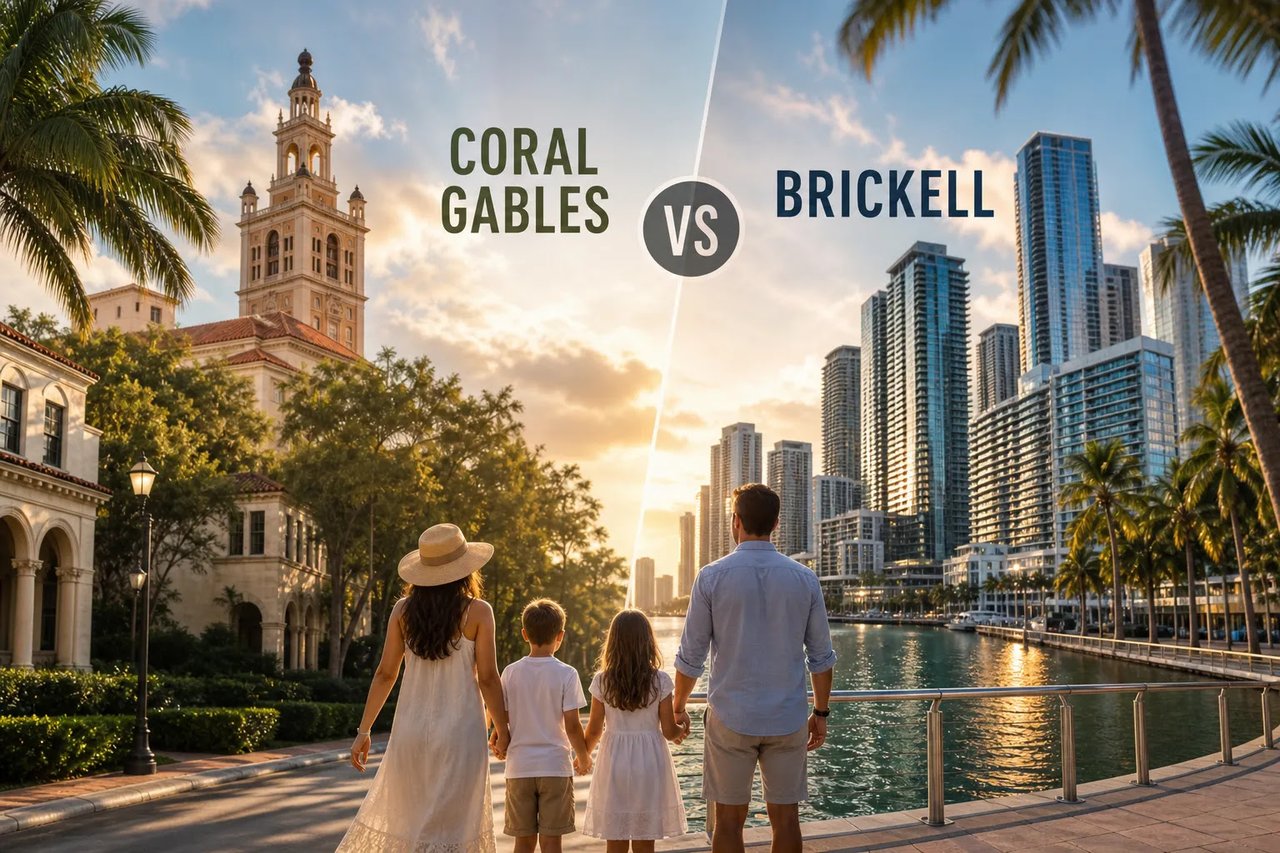
When families relocating to Miami narrow their search to Coral Gables or Brickell, they're not choosing between a good neighborhood and a great one. Both are prestigious, both sit firmly within Miami's luxury real estate market, and both attract high-achieving professionals with real purchasing power. The tension is subtler than that: these two neighborhoods deliver fundamentally different daily experiences for parents raising children, and the gap only widens as kids get older. So when it comes to Coral Gables vs. Brickell Miami, which is better for families? The answer depends almost entirely on how your household is structured and what you need from a neighborhood on an ordinary Tuesday.
This comparison draws on the same five dimensions that come up in nearly every family relocation conversation: schools, safety, outdoor space, housing type, and daily commute logistics. Work through each one against your family's actual priorities, and the right answer tends to emerge clearly. By the end, you'll have a practical framework to make that call, plus a clear next step for putting it into action.
Coral Gables vs. Brickell Schools: Where the Comparison Stops Being Close
For most relocating families, schools are the first question and, often, the deciding one. When weighing Coral Gables vs. Brickell for families, this is the dimension where the gap is most measurable and most consequential. Coral Gables holds a meaningful, data-backed advantage in public education. Brickell doesn't lack options, but it requires a more deliberate strategy from day one.
Coral Gables public schools: consistently A and B rated
According to the city of Coral Gables, all but one of its public schools earn an A or B in Florida's state school grading system, and recent academic years have pushed nearly the entire roster to A grades (Florida Department of Education school accountability reports). Coral Gables Preparatory Academy carries a 10/10 GreatSchools rating with 72% math proficiency and 76% reading proficiency, placing it among the top elementary programs in Miami-Dade. Ponce de Leon Middle has climbed from a C to a B, and Coral Gables Senior High anchors the neighborhood's high school zoning. For families who want strong public-school zoning without relying on competitive magnet applications or private tuition, Coral Gables delivers that reliably.
Brickell's school zones and what families actually do
Brickell's zoned public schools tell a different story. Southside Elementary (now Southside Preparatory Academy) rates 6/10 on GreatSchools, and Shenandoah Middle School—Brickell's zoned public middle school—comes in at 5/10, both noticeably below the Coral Gables baseline. The practical implication is straightforward: many families in Brickell build their school plan around private options or competitive magnet applications before they ever sign a lease or close on a condo, a pattern local agents and relocation specialists consistently observe. Mast Academy, rated 10/10 with approximately 91% math proficiency, is a genuine nearby option, but it requires active enrollment pursuit rather than automatic zoning. Families who are committed to private schooling regardless of neighborhood will find this less disqualifying; families counting on public school zoning will find it significant.
Safety and Neighborhood Atmosphere for Families
Crime statistics only tell part of the story. The other part is the texture of daily life: whether kids can play outside, whether parents recognize their neighbors, and whether the street-level environment feels designed for families or for something else entirely.
What the numbers show for Coral Gables
Coral Gables reports a violent crime rate between approximately 1.0 and 2.9 per 1,000 residents depending on the data source and methodology, consistently placing it among the safest communities in Miami-Dade. The city operates its own municipal police department, independent of Miami-Dade PD, a detail confirmed on the Coral Gables Police Department's official website, which supports consistent, neighborhood-level patrol coverage. The result is a residential environment that families who have relocated from the Northeast, among others, consistently describe as calm: kids on bikes, open front yards, and a recognizable community presence on the streets.
Brickell's urban environment and what it means in practice
Brickell's violent crime rate comes in around 5.0 per 1,000 residents in recent neighborhood-level data, roughly 70% higher than Coral Gables on a per-resident basis, though it's worth noting that the two figures draw from different reporting methodologies and should be read as directional rather than precisely comparative. That doesn't make Brickell unsafe in absolute terms, but it reflects the nature of a dense urban corridor rather than a residential enclave. High pedestrian density, constant street-level activity, and a largely transient residential population make it harder to build the block-level community feel that many parents prioritize. The "knowing your neighbors" quality that characterizes Coral Gables doesn't replicate easily in a building of 300 units accessed by shared elevators.
Coral Gables vs. Brickell for Families: Parks, Green Space, and Room to Play
This is where the gap between the two neighborhoods becomes most visible, and most consequential for families with active children. Coral Gables offers walkable park access woven into the residential fabric; Brickell offers waterfront aesthetics with meaningful limitations on scale and programming.
Coral Gables: 60+ parks and a genuine outdoor culture
Coral Gables manages over 60 parks and open spaces through its Community Recreation department, a figure documented in the city's parks directory, anchored by the War Memorial Youth Center on University Drive. Salvadore Park on Andalusia Avenue offers a playground and tennis courts within walking distance of residential streets. Phillips Park on Menores Avenue includes kid-focused amenities, and Matheson Hammock Park, with its family beach area and picnic grounds along Old Cutler Road, functions as the neighborhood's crown outdoor space. The defining characteristic isn't just the quantity; it's the walkable proximity of these parks to residential blocks. Spontaneous outdoor time is a natural part of daily life in Coral Gables, not a scheduled trip requiring a parking strategy.
Brickell's outdoor options: waterfront appeal with real limitations
Brickell has parks with playground equipment within a mile of Brickell Avenue.Parks like Brickell Key Park and nearby Alice Wainwright Park offer bayfront access and waterfront aesthetics, while Southside Park on SW 11th Street provides an inland green playground in the heart of the high-rise district. What's less developed is the scale: youth recreation programming is limited compared to Coral Gables, and there are few sprawling green corridors where children can move freely outside of a structured activity. Based on what residents and agents consistently observe, Brickell's outdoor spaces suit the lifestyle of a young professional or a couple; for families, they function more as a workaround than a defining asset.
Housing Type and What Your Money Actually Buys
Housing type shapes family lifestyle in ways that square footage alone doesn't capture. The choice between a single-family home and a luxury condo isn't purely aesthetic; it determines how your family moves through daily life for years.
Coral Gables: single-family homes, yards, and room to grow
Coral Gables is predominantly a single-family home market, with a current median sale price in the range of $1.6M to $1.8M across recent reporting periods. That investment delivers a private yard, garage parking, dedicated bedrooms for each child, and a residential neighborhood layout that matches how families with kids actually live. The neighborhood's architectural identity, defined by Mediterranean Revival streetscapes and canopy-lined roads, adds a sense of permanence and community that high-rise living doesn't replicate. Approximately 22.8% of Coral Gables households include children under 18, a figure that reflects the neighborhood's genuine family density.
Brickell: luxury condos and the vertical family lifestyle
Brickell's inventory is overwhelmingly luxury condo towers. A two-bedroom unit currently carries a median sale price near $700,000, while a three-bedroom comes in around $1.275 million, accessible at the entry of the luxury market but representing a fundamentally different living format. For some families, the amenity deck, rooftop pool, and concierge services work well, particularly when children are very young. For others, the absence of private outdoor space, the logistics of elevator living with strollers and sports equipment, and the noise of urban street-level activity tip the balance. Only about 14% of Brickell households include children under 18, which reflects the reality of who the neighborhood currently serves.
Commute, Daily Logistics, and the Rhythms of Family Life
For dual-income households, the commute question often carries as much weight as the school question. Getting to work efficiently is one calculation; managing the full daily logistics of a family is another.
Getting to work: Brickell's proximity versus Coral Gables' transit access
Brickell sits adjacent to Downtown Miami and the financial district, making it effectively a zero-commute neighborhood for professionals whose offices are in that corridor. For Coral Gables residents, Metrorail connects to downtown in roughly 10 to 30 minutes depending on the starting point and transfers, with trains running every 10 minutes and standard fares at $2.25. The city also operates the free Coral Gables Trolley system, which seamlessly connects downtown Coral Gables to the Douglas Road Metrorail station. For families where both parents work in Brickell or Downtown Miami, Brickell's proximity is a genuine advantage that compounds over time.
Daily family logistics: where the suburban layout earns its value
Shift the equation to school drop-offs, extracurricular pickups, weekend activities, and the weekly grocery run, and Coral Gables' suburban grid earns its keep. Car-friendly streets, accessible parking, and the spatial layout of a residential neighborhood make the full management of a family's schedule more practical than navigating a dense urban core, a trade-off that parents with multiple children and packed activity calendars consistently cite when explaining why they moved outward from Brickell. Brickell's walkability is excellent for young professionals; it's less optimized for parents juggling multiple children, activity schedules, and the errand load that defines family life.
Which Is Better for Families, Coral Gables or Brickell?
There is a clear pattern in how families self-select between these two neighborhoods, and it maps consistently to a handful of priorities.
Two different family profiles, two different answers
Families who prioritize strong public school zoning, ample green space, a true neighborhood community, and a home with a private yard will consistently find Coral Gables the stronger fit. The available data supports that conclusion across the key dimensions in this comparison, schools, parks, safety, and housing type, with the caveat that some data points carry different source methodologies. Families where both parents work in Brickell or Downtown Miami, have already committed to private schooling, and prefer the convenience and amenities of a high-rise lifestyle may find Brickell serves them well, particularly as a first step before moving outward as kids reach school age. Both answers are legitimate; they reflect different household priorities, not different levels of ambition.
The next step: walk the neighborhoods before deciding
No article captures what a Saturday morning at Matheson Hammock feels like compared to a walk along Brickell Key, or what it's like to navigate school pickup on a residential Coral Gables street versus the blocks surrounding a downtown private school. The most useful thing any relocating family can do is spend time in both neighborhoods on a weekday morning and a weekend afternoon before committing. Tour the schools, talk to residents at the park, and notice how each neighborhood feels when life is actually happening in it.
Working with an agent who has placed families in both Coral Gables and Brickell makes that evaluation faster and more targeted. Elaine Kauffmann specializes in helping relocating families navigate exactly this decision across Miami-Dade's luxury submarkets, from identifying the right school districts to knowing which buildings and streets align with each family's specific profile. If you're working through the Coral Gables vs. Brickell Miami question for your own household, that kind of on-the-ground guidance is where the decision moves from theoretical to concrete. Reach out to start the conversation.