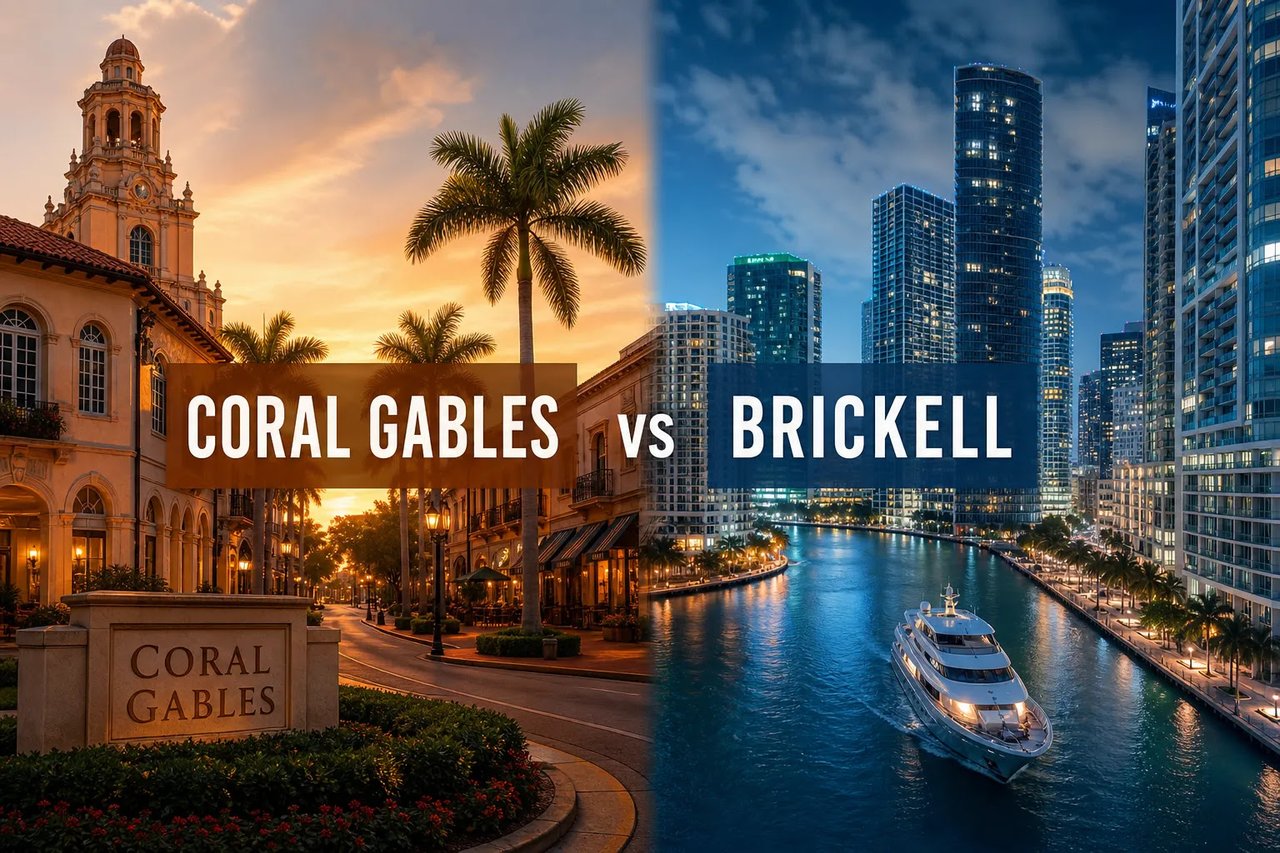
The question of Coral Gables vs Brickell comes up constantly among Miami luxury buyers, and for good reason. Both neighborhoods carry the Miami luxury label, but they serve two very different versions of a well-lived life. One offers tree-canopied streets, Mediterranean estates, and a pace that feels curated rather than rushed. The other pulses with glass towers, rooftop terraces, and a walkable urban energy that draws executives and global investors alike.
This is one of the most common questions Elaine Kauffmann fields from buyers: Coral Gables or Brickell? With deep experience representing clients on both sides of this decision throughout Miami's luxury market, she knows the "right" neighborhood has everything to do with how you actually want to live, not just where you want to be seen. This article breaks down what each neighborhood truly delivers in 2026 across lifestyle, price, schools, commute, and investment potential, so you can make the call with confidence.
Two Different Miamis: Architecture, Character, and Daily Feel
Coral Gables was developed in the 1920s by George Merrick, and it shows. The neighborhood's signature Mediterranean Revival architecture, with arched loggias, terracotta rooftops, and ornamental fountains, isn't nostalgia. It's protected by the city's historic preservation code. Banyan-lined streets, the iconic Venetian Pool, and strict zoning give Coral Gables a cohesion that feels rare in South Florida. Residents describe it as a neighborhood you actually live in rather than pass through.
Brickell earned its reputation as Miami's Manhattan, and the skyline confirms it. Luxury high-rises define a neighborhood built around vertical living, rooftop amenities, and round-the-clock urban convenience. If Coral Gables is a Sunday morning at a shaded café, Brickell is a packed Thursday evening rooftop with views of Biscayne Bay. The lifestyle is sophisticated and relentlessly active, residents find themselves embedded in the city's rhythms from the moment they step outside. Neither is better in any absolute sense. They simply answer different questions about how you want your days to feel.
Coral Gables vs Brickell: What Your Budget Actually Buys
The median home sale price in Coral Gables sits at approximately $1.65M to $1.7M in 2026, with single-family homes accounting for the majority of transactions. At that price point, buyers typically get a 3- to 4-bedroom residence with a yard, garage, and a streetscape that photographs beautifully. Luxury condos in the area push median list prices toward $3.5M, but the neighborhood's appeal is fundamentally tied to its homes and the land beneath them.
Brickell offers a lower entry point, with the broader condo market ranging from $600K to $660K at the median across all unit types. The luxury segment tells a different story: luxury condos in Brickell posted a median sale price of approximately $1.7M in Q1 2026, a 13.9% increase from the prior year. That accessibility comes with real carrying costs. HOA fees in premium Brickell buildings run $1,200 to $5,000 per month depending on the tower and unit size, and the primary metric here is condo square footage and floor plan rather than lot size. For buyers comparing these two neighborhoods, understanding the full carrying cost of each is essential before drawing any conclusions from the list price alone.
Coral Gables vs Brickell: Schools, Safety, and What Families Need to Know
For families making this decision with children in mind, Coral Gables is the stronger candidate by a wide margin. The neighborhood's zoned public schools earn mostly A and B grades from the Florida Department of Education, and Coral Gables Senior High School remains one of Miami-Dade's most respected options. The area also sits close to well-regarded private institutions, including Gulliver Preparatory, which offers a 7:1 student-teacher ratio for pre-K through 12th grade.
Brickell does have standout options. Mast Academy earns a 10/10 on GreatSchools, and the School for Advanced Studies campuses rank among the top high schools in Florida. The difference is consistency: Coral Gables delivers uniformly high-rated public schools across the neighborhood, while Brickell shows more variation, making school zone research more critical for families buying there.
Safety by the Numbers
On safety, the data tilts clearly toward Coral Gables. The city recorded a violent crime rate of 110.4 per 100,000 residents in 2024, which is 61% below the Florida state average, and it earned an "A" safety grade in 2026. Brickell, as a high-density downtown district, sees the higher property crime rates typical of dense urban cores. Neither neighborhood is unsafe by Miami standards, but for families weighing schools and neighborhood infrastructure together, Coral Gables holds the stronger position.
Commute, Walkability, and How You'll Move Through Your Days
Brickell earns a Walk Score of 94 to 99, a "Walker's Paradise" rating, and a Transit Score between 82 and 96. The free Metromover loops through the neighborhood and connects to the Metrorail. You can live car-free here without much sacrifice. Getting to downtown Miami from Brickell is a five-minute walk at most, and a drive to Miami International Airport runs about 15 to 20 minutes. Living in Brickell means your commute is largely solved before you leave the building lobby.
Coral Gables scores around 60 to 70 for walkability, functional but clearly suburban by comparison. The Metrorail serves the neighborhood via the Vizcaya and Coral Gables stations, but there is no Metromover access, and most daily errands require a car. The drive to downtown Miami runs 15 to 25 minutes depending on traffic, and to MIA, roughly 20 minutes. The parking situation is considerably more relaxed than Brickell, with residential zones offering free street parking in many areas and far lower garage costs than the $150 to $250 per month typical of Brickell. For buyers who work remotely or value a slower pace over transit convenience, this tradeoff is entirely livable.
The Buyer Who Belongs in Each Neighborhood
The Coral Gables buyer typically values permanence. They want land, architectural character, top-tier schools, and a neighborhood that feels complete on its own terms. This buyer may be raising children, putting down roots in Miami for the long term, or drawn to a home that appreciates steadily rather than speculatively. International buyers from Latin America and Europe are often drawn to Coral Gables for its residential scale and thoughtfully planned streetscapes, a familiar sensibility for those coming from cities with strong urban design traditions.
The Brickell buyer is often optimizing for mobility, convenience, and return. Young executives, financial professionals, and investors purchasing a Miami base or a short-term rental asset will find Brickell purpose-built for their needs. The lock-and-leave lifestyle, rooftop amenities as social infrastructure, and proximity to Miami's financial district all serve this profile well.
Investment Yield: Where the Neighborhoods Diverge
Luxury condos in Brickell post gross long-term rental yields of 3% to 7.3%, and select buildings that permit short-term rentals can generate 6% to 9% gross yields, though net returns run lower after HOA fees and management costs. Coral Gables single-family homes typically yield 3% to 5% gross but tend to offer stronger long-term equity appreciation, driven by land scarcity and strict zoning that limits new supply. Depending on your strategy, either neighborhood can perform. The question is whether you're prioritizing income today or equity over a decade.
Making the Final Call: The Questions That Actually Decide It
Before choosing between these two neighborhoods, answer a few direct questions. Do you need a yard, or will a 42nd-floor terrace with bay views serve the same purpose? Are there school-age children in the picture now or in the next five years? Is the priority a primary residence that builds equity quietly, or a Miami address that doubles as a lifestyle investment with rental income potential? These questions cut through the noise faster than any comparison chart.
Market data provides direction, but it doesn't walk you through a specific building's reserve fund, flag a Coral Gables estate with deferred maintenance behind beautiful bones, or tell you which Brickell tower has the healthiest rental restrictions for your strategy. Elaine Kauffmann has represented buyers and sellers in both Coral Gables and Brickell and brings firsthand knowledge of the nuances that never appear in a listing. That kind of on-the-ground expertise changes the quality of the decision entirely.
The Bottom Line
When weighing Coral Gables vs Brickell, recognize that both represent two of Miami's strongest luxury markets for entirely different reasons. One delivers a curated residential life with architectural heritage, top schools, and land that holds its value over time. The other delivers urban convenience, transit access, and investment-grade inventory that attracts a global buyer pool. The sharper question isn't which neighborhood is better, it's which one is built for the life you're actually planning to live.
The clarity comes when you're honest about what you need a property to do for you over the next decade. If you're still weighing this decision or want to tour properties in either neighborhood with someone who knows both from the inside, reach out to Elaine Kauffmann, it's the conversation worth having before you commit.