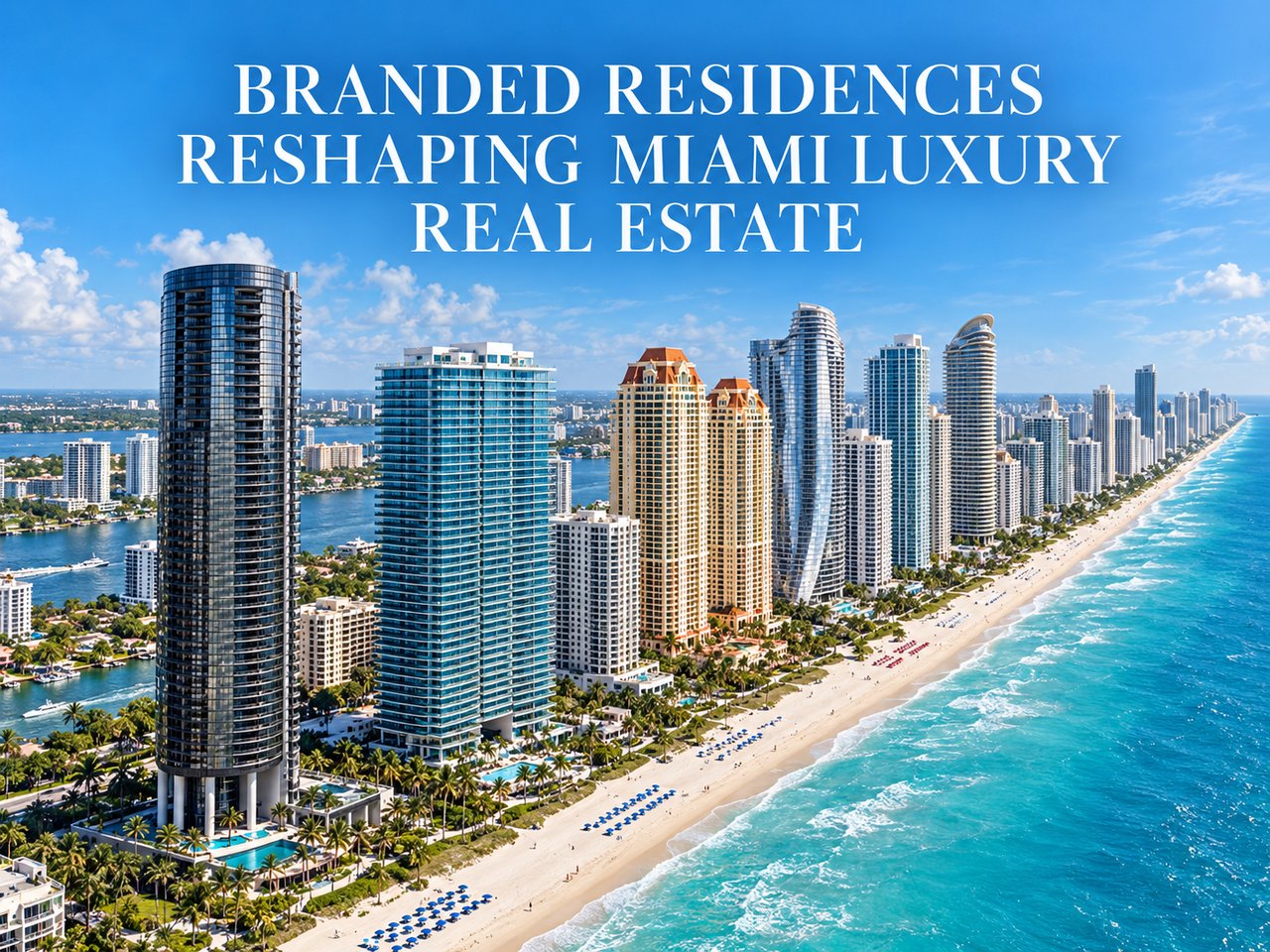
Branded residences from automotive, hospitality, and luxury fashion houses are commanding significant price premiums over comparable non-branded new development in Miami, with established hospitality brands showing 28–38% premiums in mature markets like Miami, according to a 2026 global branded residences investment analysis. International buyers are locking in contracts two to four years ahead of delivery, and the pipeline now spans Sunny Isles Beach, Brickell, and Downtown Miami. For buyers weighing whether the premium is justified, the answer depends on the specific brand, submarket, and your investment horizon.
Key Takeaways
- Established hospitality-branded residences in Miami carry 28–38% price premiums over comparable non-branded luxury condos, per a 2026 global branded residences analysis.
- Miami luxury condo sales volume rose 15.2% year-over-year in Q1 2026, even as the median price per square foot dipped 3.7% to $1,040, signaling a buyer's market backdrop for branded launches.
- Foreign buyer activity in South Florida pre-construction reached $4.4 billion in Q1 2026, up 42% year-over-year, with branded towers capturing a large share of that international capital.
- New luxury development in Sunny Isles Beach, home to Bentley Residences and St. Regis Sunny Isles, is benchmarking around $2,000 per square foot as of July 2026.
- Pre-construction luxury prices across Miami grew 12–18% year-over-year in Q1 2026, with Brickell commanding the highest per-square-foot premiums in new development.
What is driving the branded residence boom in Miami?
Miami has become one of the world's top markets for branded residences, and the reasons aren't hard to see from where I sit. Over the past 14 years I've watched the city's luxury condo market evolve from a handful of trophy towers to a full ecosystem of hospitality, automotive, and fashion-house brands competing for the same waterfront parcels.
The demand side is genuinely global. According to a Q1 2026 pre-construction market report from LuxuryDade, foreign buyer activity in South Florida's pre-construction segment reached $4.4 billion in Q1 2026, up 42% year-over-year. A significant portion of that capital flows directly into branded towers, where an internationally recognized name reduces the due-diligence burden for a buyer purchasing from abroad.
The supply side has responded accordingly. Automotive brands like Aston Martin and Bentley, hospitality giants like Waldorf Astoria and St. Regis, and luxury fashion houses have all staked claims across Miami's submarkets. Each brings a distinct design language, service model, and amenity stack that a standard luxury condo simply can't replicate. For a deeper look at how the Aston Martin project specifically is positioned, I've covered it in detail in my Aston Martin Residences Miami guide.
The broader luxury condo market context matters here. According to Condo Blackbook's Q1 2026 luxury condo market report, Miami-Dade luxury condo sales volume rose 15.2% year-over-year in Q1 2026, the strongest first quarter outside pandemic-era surges. At the same time, the median price per square foot closed at $1,040, a 3.7% year-over-year decline. Strong volume with softening per-foot pricing is the definition of a buyer's market, and it raises a real strategic question: does the brand premium hold when the broader market is normalizing?
Where are branded towers concentrated?
Sunny Isles Beach has the densest cluster of oceanfront branded projects right now. A July 2026 market update from Haute Living pegs new luxury development benchmarks in Sunny Isles Beach at around $2,000 per square foot, with starting prices at the $5 million-plus level, and flags Bentley Residences and St. Regis Sunny Isles as the anchor projects in that submarket.
Brickell commands the highest pre-construction premiums on a per-square-foot basis across Miami's submarkets, according to LuxuryDade's Q1 2026 report, with average luxury pre-construction prices ranging from $800 to $1,500 per square foot across the city. Downtown Miami and Edgewater round out the pipeline. Each submarket has a different value proposition, and I walk my clients through those distinctions before they commit to a contract.
Here's a snapshot of where the broader luxury market stands across the areas I work, based on recent local market data (trailing approximately 90 days, as of September 2026). These are area-level medians across all property types, not branded-only figures:
Area | Median Sale Price | Median Days on Market |
|---|---|---|
Coral Gables | $2,500,000 | 42 |
Coconut Grove | $2,675,000 | 47 |
Brickell | $1,708,450 | 87 |
South Miami | $1,887,500 | 56 |
Key Biscayne | $1,577,500 | 54 |
Edgewater | $1,528,812 | 89 |
Branded new development sits well above these area medians, which is exactly the point. Buyers in this segment aren't cross-shopping a resale condo in Brickell against a Bentley Residences contract. They're evaluating a differentiated product category.
Is buying a branded residence in Miami actually a good investment?
This is the question I get most often, and I'll give you the honest answer: it depends on which brand, which building, and what you're measuring.
The premium is real and well-documented. The 2026 branded residences investment analysis from LuxuryEstate Journal puts established hospitality-brand premiums at 28–38% over comparable non-branded product in mature markets like Miami. Buyers often frame this as paying up for downside protection: a globally recognized brand creates a differentiated asset that may hold its value better in a downturn than an undifferentiated luxury condo.
The pre-construction growth numbers support the optimism, at least through early 2026. According to LuxuryDade's Q1 2026 pre-construction report, luxury pre-construction prices grew 12–18% year-over-year in Q1 2026, with projected growth of 10–16% year-over-year heading into the remainder of 2026. For buyers who locked in contracts two or three years ago, those numbers look compelling.
But the risks are real too, and I'd be doing you a disservice if I glossed over them. Pre-construction timelines shift. Delivery dates move. The broader luxury condo market, as Condo Blackbook's Q1 2026 summary documents, is showing per-foot price softening even as volume accelerates. A branded tower being marketed today at a significant premium is entering a market where buyers have more negotiating leverage than they did two years ago. The brand premium has to be resilient enough to hold through that normalization cycle.
My honest advice: the investment case is strongest for buyers with a five-plus year horizon who are also buying for lifestyle reasons. If you're purely speculating on a flip at delivery, the math is harder to make work in this environment. Every situation is different, and the only way to know for sure is to run the numbers with someone who knows this market and the specific project you're evaluating. That's exactly the kind of analysis I do before my clients sign anything.
What do ongoing fees look like in branded buildings?
Branded residences carry higher HOA and service fees than standard luxury condos. The brand's management arm typically operates the building's amenities and services, and that overhead is passed through to residents. You're paying for white-glove concierge, hotel-style housekeeping availability, valet, spa, and food and beverage programming that a conventional building doesn't offer.
This matters for investment analysis because higher carrying costs compress net yield if you're renting the unit. It also matters in the current market context: one of the factors Condo Blackbook identified in its Q4 2025 and annual summary as contributing to the buyer's market dynamic in luxury condos is the sharp rise in monthly HOA costs across conventional buildings as insurance premiums and mandatory legislative reserve requirements (SIRS) take effect. While branded buildings start with inherently elevated service models and higher baseline fees, new luxury developments already incorporate fully funded reserves into their initial budget structures, insulating buyers from the sudden special assessment shocks hitting older non-branded inventory. Verify the HOA fee structure, reserve breakdown, and developer budget for any specific building before you contract.
For a broader look at how Miami's condo market is shifting right now, my post on the Miami condo market's move toward a buyer's market in 2026 covers the macro dynamics that affect branded and non-branded product alike.
What international buyers need to know about closing on a branded condo in Miami
International buyers make up a large share of the branded residence buyer pool, and there are a few Miami-specific closing mechanics worth understanding before you're at the contract stage.
While Florida law permits licensed title companies to handle settlement, international luxury transactions almost universally rely on a real estate attorney to manage closing, hold escrow, and review complex developer agreements. Building a Florida-licensed real estate attorney into your advisory team early ensures your deposit funds and contractual rights are fully protected.
On the tax side, Florida imposes a documentary stamp tax on deeds transferring real property under Chapter 201, Florida Statutes. In Miami-Dade County, the base tax rate for residential real estate—including individual condominium units—is $0.60 per $100 of consideration. While Miami-Dade levies an additional $0.45 surtax per $100 on commercial property and multi-family structures, individual residential condos are legally classified as single-family residences and are exempt from this surtax. Florida Department of Revenue guidelines confirm that all parties to a taxable document are legally liable for the tax, though responsibility for payment is negotiated in the purchase contract (where sellers typically cover deed stamps).
For international buyers, there are also federal tax considerations around foreign ownership of U.S. real property that fall outside my lane as a real estate broker. You'll want a U.S. tax attorney or CPA with international real estate experience on your team. The IRS's FIRPTA guidance is the starting point for understanding withholding obligations on disposition.
The billionaire migration trend that has fueled so much of Miami's luxury demand is something I've written about separately, and the tax and residency dynamics driving that migration are directly relevant to branded residence buyers. You can read that analysis in my post on how billionaire migration is reshaping Miami real estate.
Frequently Asked Questions
Are branded residences like Aston Martin and Bentley in Miami actually a better investment than regular luxury condos?
They carry a documented premium, with established hospitality brands showing 28–38% price premiums over comparable non-branded product in mature markets like Miami, according to a 2026 global branded residences analysis. Whether that premium translates to better investment performance depends on your time horizon, the specific brand's management track record, and resale demand in that submarket. Buyers with a five-plus year horizon who are also buying for lifestyle reasons tend to have the strongest case; short-term speculators face a harder math in the current buyer's market environment.
What price premium do Miami branded residences charge compared to non-branded buildings?
In Miami, established hospitality-branded residences command 28–38% premiums over comparable non-branded luxury new development, per a 2026 branded residences investment analysis. In Sunny Isles Beach specifically, new luxury development is benchmarking around $2,000 per square foot as of July 2026, with starting prices at the $5 million-plus level. Pre-construction luxury prices across Miami grew 12–18% year-over-year in Q1 2026, with Brickell commanding the highest per-foot premiums.
How risky is buying a pre-construction branded residence in Miami if the delivery date moves or the market softens?
Pre-construction risk is real: delivery timelines shift, and you're committing capital years before you take possession. The broader Miami luxury condo market showed per-foot price softening in Q1 2026, even as sales volume rose 15.2% year-over-year, which means a branded tower delivering into that environment needs its brand premium to hold through a normalization cycle. Mitigating factors include strong international demand (foreign buyer activity in South Florida pre-construction was up 42% year-over-year in Q1 2026) and the differentiated service model that branded buildings offer. Review the developer's track record, the contract's default and deposit-refund provisions carefully with your real estate attorney before signing.
Which Miami neighborhoods have the most branded luxury towers?
Sunny Isles Beach has the densest concentration of oceanfront branded projects, anchored by Bentley Residences and St. Regis Sunny Isles, with new development benchmarks around $2,000 per square foot as of July 2026. Brickell and Downtown Miami have significant branded pipelines as well, with Brickell commanding the highest pre-construction per-foot premiums across Miami's submarkets. Edgewater and the broader Miami Beach corridor also have branded projects in various stages of development.
As an international buyer, what should I know about taxes and closing costs on a branded condo in Miami?
Florida imposes a documentary stamp tax on the deed at closing; in Miami-Dade County, individual residential condos qualify as single-family residences and are taxed at $0.60 per $100 of consideration, remaining exempt from the county's $0.45 commercial surtax. Which party pays is negotiated in the purchase contract, though standard practice places deed stamps on the seller. Beyond state transfer taxes, federal FIRPTA withholding rules apply to foreign sellers upon disposition. International buyers should engage a Florida real estate attorney to manage escrow and settlement, alongside a U.S. tax advisor.
Branded residences are genuinely reshaping what luxury ownership means in Miami, and the pipeline of automotive, hospitality, and fashion-house projects coming to market over the next few years makes this one of the most consequential segments to watch. Whether you're evaluating a specific contract or still deciding which submarket fits your goals, the analysis is always specific to the building, the brand, and your timeline.
I represent buyers and investors across Brickell, Sunny Isles Beach, Coral Gables, Coconut Grove, and Key Biscayne in exactly these transactions. If you're ready to work through the numbers on a specific branded project, schedule a consultation with me directly and we'll start with a clear-eyed look at what the premium is actually buying you.
Equal Housing Opportunity. Elaine Kauffmann, Broker Associate, licensed in Florida. This article is general market information only and does not constitute legal, tax, or financial advice. Confirm all figures, tax obligations, and transaction costs with your real estate attorney, tax advisor, or lender.